
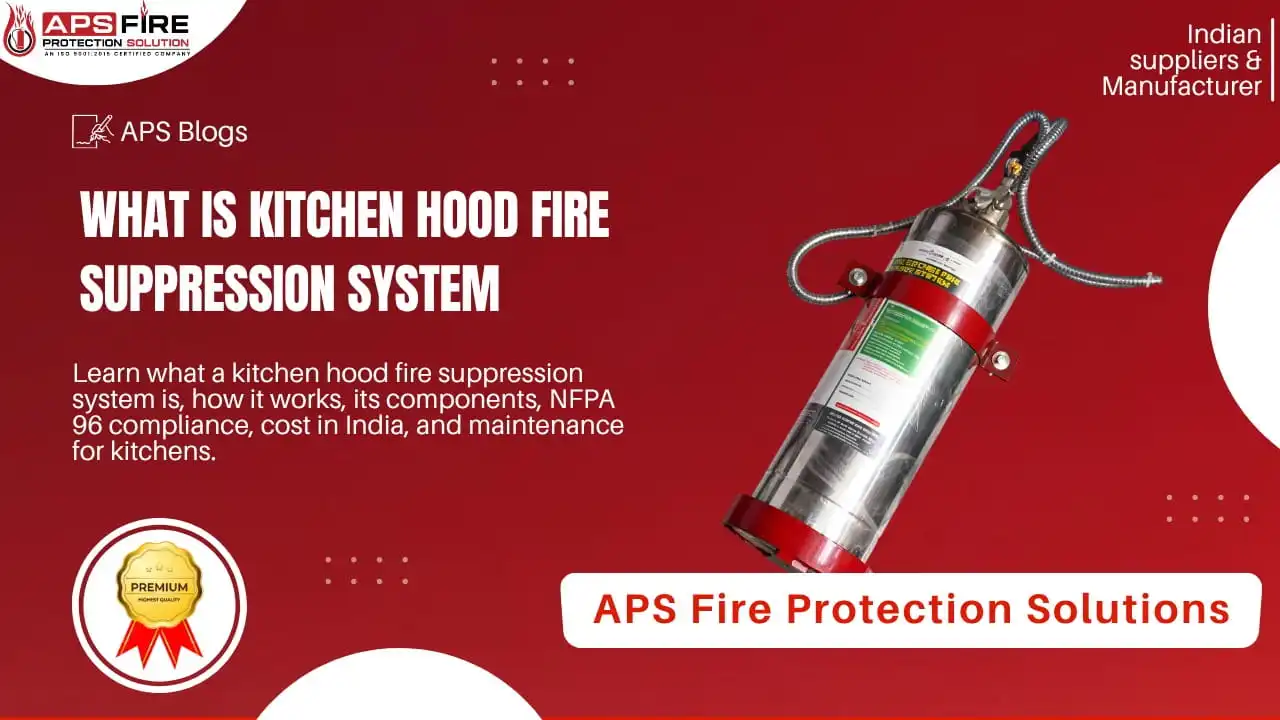
What is a Kitchen Hood Fire Suppression System? A Complete Guide for Commercial Kitchens in India
Picture this: It is a busy Friday evening in your restaurant. The deep fryers are running hot, the wok station is going full blast, and the kitchen is operating at peak capacity. A small flare-up starts at the fryer — the oil temperature has crept past its auto-ignition point. In under 60 seconds, that flare-up can travel through the grease filters, up into the exhaust duct, and become a full building fire. If your kitchen has a certified kitchen hood fire suppression system, the fire is detected and extinguished automatically in under 30 seconds — before it ever reaches the duct. If your kitchen does not have one, you are relying on a staff member to grab a fire extinguisher and fight a 350°C grease fire. That is not a bet any commercial kitchen operator should be willing to take.
A kitchen hood fire suppression system is not just a regulatory checkbox. It is the only fire protection technology specifically engineered to handle the unique chemistry of burning cooking oils and fats — the fire type that accounts for the majority of commercial kitchen fires worldwide. This guide explains exactly what the system is, how it works at a technical level, what every component does, how much it costs in India, and what maintenance it requires to keep your kitchen legally compliant and genuinely protected.
Table of Contents
- What is a Kitchen Hood Fire Suppression System?
- Why a Kitchen Hood Fire Suppression System is Critical for Your Business
- How a Kitchen Hood Fire Suppression System Works — Step by Step
- What is Saponification and Why Does It Matter for Kitchen Fire Safety?
- Key Components of a Kitchen Hood Fire Suppression System
- Types of Kitchen Fire Suppression Systems
- Benefits of Installing a Kitchen Hood Fire Suppression System
- Maintenance and Inspection Requirements
- Kitchen Hood Fire Suppression System Cost in India
- Common Mistakes to Avoid
- Frequently Asked Questions
What is a Kitchen Hood Fire Suppression System?
A kitchen hood fire suppression system is a purpose-built, automatic fire extinguishing system that lives inside the stainless steel exhaust canopy above your commercial cooking line. From the outside, it looks no different from a standard extraction hood. Inside, it contains a complete fire detection and suppression infrastructure — heat sensors, pressurised chemical cylinders, discharge nozzles, supply piping, and automatic shutoff connections to your gas line and electrical circuits.
The system exists as a completely separate category of fire protection because cooking oil fires — known internationally as Class K fires (Class F in European and Indian standards) — behave differently from every other type of fire. They burn at extreme temperatures, they spread rapidly through exhaust ducting, and they re-ignite after apparent extinguishment if the oil underneath has not been cooled below its auto-ignition point. No general-purpose fire suppression technology — not water sprinklers, not CO₂ gas systems, not dry powder extinguishers — can reliably and safely extinguish a cooking oil fire. Each of those solutions either actively makes a grease fire worse or fails to prevent re-ignition.
The kitchen hood suppression system solves this with a wet chemical extinguishing agent — a potassium-based alkaline liquid specifically formulated for cooking oil fires. When discharged, it cools the oil and simultaneously undergoes a chemical reaction called saponification that converts the burning oil surface into a non-flammable foam blanket, permanently preventing the fire from re-igniting. More on saponification shortly.
The system protects three distinct zones in one activation: the cooking appliance surfaces directly below the hood, the interior of the hood plenum and grease filters, and the duct entrance — stopping a surface fire before it can travel into the exhaust system and become a duct fire. This three-zone protection is what makes it fundamentally different from simply having a fire extinguisher in the kitchen. To understand how all automatic fire suppression systems work in general, read our foundational guide.
In India, these systems are also referred to as commercial kitchen fire suppression systems, automatic kitchen fire suppression systems, restaurant fire suppression systems, wet chemical kitchen suppression systems, and hood fire suppression systems. All these terms refer to the same core technology.
Why a Kitchen Hood Fire Suppression System is Critical for Your Business
The Real Fire Risk in Commercial Kitchens
Commercial kitchens are statistically the highest fire-risk environment in any building that is not an industrial facility. The combination of open flames, high-output gas burners, large volumes of cooking oils and fats, continuous heat exposure, and grease accumulation in hoods and ducts creates conditions where a serious fire is not a remote possibility — it is a predictable outcome if the right protection is not in place.
Cooking oil reaches its auto-ignition temperature — the point where it spontaneously combusts without a flame source — between 315°C and 375°C depending on the oil type. A commercial deep fryer operating at its normal setpoint of 180°C has only a 135°C buffer before the oil self-ignites. Any equipment fault, unattended operation, or control failure can close that gap quickly. When cooking oil ignites, the fire can grow to dangerous size in under 30 seconds and travel from the fryer through the hood into the exhaust ductwork in under 60 seconds.
A duct fire — where accumulated grease inside the exhaust duct system ignites — is one of the most catastrophic fire scenarios in a commercial building. It spreads through the ceiling space, is inaccessible to fire extinguishers, and can emerge from the duct termination on the roof while simultaneously spreading laterally through penetrations in the ceiling. This is how single restaurant kitchen fires have destroyed entire buildings. To understand how automatic fire suppression systems detect and stop fires at the source before they reach this stage, see our detailed working guide.
Legal and Regulatory Requirements in India
The National Building Code of India 2016, Part 4 explicitly mandates automatic fire suppression systems for commercial kitchen environments as part of special hazard protection requirements. Any building with a commercial kitchen above a specified area and cooking volume must have an automatic suppression system installed as a condition of building occupancy compliance.
Beyond the building code, local fire departments in Delhi, Mumbai, Bengaluru, Chennai, Hyderabad, and most other major Indian cities require a certified kitchen hood suppression system as part of the fire NOC (No Objection Certificate) process for restaurants, hotels, and food service establishments. A fire NOC cannot be renewed — and a business licence may be revoked — if the kitchen lacks a functioning, recently inspected suppression system.
Hotel classification bodies, FSSAI compliance inspectors, and commercial property insurance providers all independently verify the presence and maintenance status of kitchen fire suppression systems during their audits.
Financial Protection for Your Business
A kitchen fire without a suppression system means complete cooking equipment replacement, structural repair, regulatory shutdown during investigation, lost business revenue during closure, and potential liability for injuries. An insurance claim after a kitchen fire where no suppression system was present — or where the system was present but had lapsed maintenance — is routinely partially or entirely rejected by Indian commercial insurers. The cost of installing and maintaining a kitchen hood suppression system is a fraction of any of these individual consequences.
A kitchen fire with a functioning suppression system typically means cleaning the affected cooking station, refilling the suppression cylinder, replacing fusible links, and resuming service within hours. The difference in outcome is not marginal — it is the difference between a minor incident and a business-ending event.
How a Kitchen Hood Fire Suppression System Works — Step by Step
Understanding the complete activation sequence helps you verify that your system is correctly installed and helps your staff know exactly what to expect during an activation event.
Step 1 — Continuous Heat Monitoring
The system is always active. Inside the hood plenum — the enclosed space above the grease filters — fusible links are installed at multiple positions, directly above each cooking appliance. A fusible link is a small two-piece metal connector held together by a low-melting-point solder alloy. The link is connected to a continuous detection cable that runs through the hood under tension. During normal kitchen operation at safe temperatures, nothing happens. The system simply monitors.
In systems with electronic detection, thermostatic heat sensors constantly measure the temperature inside the hood and send readings to a control panel. These sensors can be calibrated more precisely and respond faster than fusible links in certain scenarios, and they can integrate with the building's main fire alarm system for centralised alerting.
Step 2 — Fire Detection and Automatic Trigger
When a fire breaks out at a cooking surface, the temperature inside the hood rises rapidly. When the temperature at any fusible link reaches its rated activation threshold — typically 182°C to 260°C depending on the appliance type and system design — the solder alloy melts, the link separates into two pieces, and the cable under tension snaps free. This mechanical release immediately triggers the spring-loaded actuator on the wet chemical storage cylinder.
This entire process from fire ignition to system trigger typically takes 15 to 30 seconds in a properly functioning system — fast enough to intercept the fire before it reaches the grease filters and duct. In electronic detection systems, the response can be slightly faster because the sensor does not need to physically melt.
Step 3 — Wet Chemical Agent Discharge Through Nozzles
Once the cylinder valve opens, nitrogen pressure drives the wet chemical agent through the supply piping and out through the discharge nozzles in a fine mist. The nozzles are positioned precisely above each cooking appliance and inside the hood plenum. Each nozzle type and position is calculated by a certified fire protection engineer — a nozzle above a deep fryer has a different type, angle, and height from a nozzle above a gas range or a griddle, because the geometry and fire behaviour of each appliance differs.
The agent blankets the cooking surface, the oil in the fryer vessel or pan, the grease filters, and the hood interior. The entire discharge takes 30 to 60 seconds depending on system size and the volume of agent required to cover the protected area. The nozzle layout is a critical part of the engineering — you can see how our certified kitchen hood fire suppression systems are designed for full cooking zone coverage.
Step 4 — Saponification Permanently Stops the Fire
As the wet chemical agent contacts the burning cooking oil, two things happen simultaneously. First, the agent physically cools the oil surface by absorbing heat — pulling the oil temperature down toward its safe range. Second — and more importantly — the potassium-based agent undergoes saponification: it chemically reacts with the fatty acids in the hot cooking oil and converts the oil surface layer into a thick, non-flammable, soapy foam. This foam physically seals the oil surface from oxygen, preventing the fire from burning even if the oil underneath is still warm. The foam layer remains stable after the agent discharge ends, providing continued protection against re-ignition — something no other extinguishing agent can do for cooking oil fires.
Step 5 — Automatic Gas and Power Shutoff
Simultaneously with agent discharge, the suppression system mechanically trips the gas shutoff valve on the gas supply line feeding all cooking appliances under the hood. This cuts the fuel source, preventing any gas burner from continuing to heat the oil or providing an ignition source for re-ignition after the agent disperses. An electrical interlock also cuts power to electrically operated cooking equipment, eliminating sparking hazards.
Both shutoffs are mechanical and do not require electrical power to operate — they function during a power failure. Gas cannot be restored until a qualified technician manually resets the valve and confirms the system is recharged and safe.
Step 6 — Manual Pull Station as Staff Backup
Every certified kitchen hood suppression system includes at least one manual pull station — a red handle mounted near the kitchen exit between 1.2 and 1.5 metres above the floor. If staff observe a fire before the automatic system triggers, or if the automatic system has not activated for any reason, pulling the handle immediately initiates the full discharge sequence including agent release and gas/power shutoff. All kitchen staff must know where the manual pull station is and how to use it. It must never be obstructed.
Step 7 — Alarm Notification
In integrated systems, the suppression activation sends a signal to the building fire alarm control panel, triggering building-wide evacuation alarms and — where connected to a central monitoring station — automatically alerting the fire brigade. Even in kitchens without full building integration, the system can trigger a local alarm bell or buzzer to alert everyone in the immediate area.
What is Saponification and Why Does It Matter for Kitchen Fire Safety?
Saponification is the specific chemical reaction that makes wet chemical kitchen hood systems the only truly effective solution for cooking oil fires. Understanding it explains why you cannot substitute any other type of suppression agent for a kitchen system.
When a potassium-based alkaline agent contacts hot cooking fat or oil, the potassium reacts with the fatty acids present in the oil in an alkali-fat reaction. This reaction converts the oil surface into potassium soap — a thick, viscous, non-flammable foam. The word saponification comes from the Latin sapo, meaning soap. The cooking oil, in contact with the potassium agent, is literally being converted into soap on its surface.
This foam layer does three things simultaneously. It physically separates the hot oil from the surrounding oxygen, removing the oxidiser that combustion needs. It insulates the oil surface, slowing further heat transfer from the burning oil into the air above. And it continues to cool the oil mass below as additional agent reaches the surface. Even after the agent cylinder is empty and discharge has ended, the foam layer remains in place on the oil surface, providing ongoing protection for as long as it takes the oil to cool to a safe temperature.
This is the critical distinction from every other suppression agent. CO₂ excludes oxygen temporarily but provides no cooling and no physical barrier — the moment the CO₂ concentration disperses, the 350°C oil is exposed to air and immediately re-ignites. Dry powder interrupts the combustion chain reaction but similarly provides no lasting surface seal. Water is actively dangerous — it instantly flashes to steam on 350°C oil, creating a violent boilover. Only the saponification produced by wet chemical agents creates a permanent physical and chemical barrier on the oil surface that continues to protect against re-ignition after the discharge ends.
Key Components of a Kitchen Hood Fire Suppression System
A properly engineered kitchen hood fire suppression system is not a single device — it is a network of interdependent components. The failure of any single one can compromise the entire system's performance during a real fire. Here is what each component does and what goes wrong when it is neglected.
Wet Chemical Storage Cylinder
The pressurised stainless steel cylinder contains the wet chemical extinguishing agent — a potassium-based alkaline liquid — stored under nitrogen pressure. Cylinders are available in capacities from 1.5 litres to 25 litres, with the required size determined by the total area and volume of cooking appliances, hood, and duct to be protected. The cylinder is the agent reservoir — if it has not been recharged after a previous discharge, or if it has leaked pressure, it will discharge either no agent or insufficient agent during a real fire. View the certified kitchen hood fire suppression systems we supply and install across commercial kitchens in India.
Cylinder Valve and Actuator
A spring-loaded mechanical actuator on the cylinder valve is held closed by tension on the detection cable. When the fusible link melts and the cable releases, the spring fires and opens the valve instantly. The actuator can also be triggered electrically in advanced systems. If the actuator has corroded, the spring has fatigued, or the cable connection has been disturbed, the cylinder will not open during a fire regardless of what the detection system detects.
Fusible Links and Detection Cable
Fusible links are the primary fire detection mechanism. They are small two-piece metal links soldered together with an alloy rated to melt at a specific temperature — typically 182°C for standard applications. They are connected in series along a continuous cable running through the hood. When any link melts, the cable releases and triggers the system. Fusible links coated in grease are insulated from heat and may not melt at the correct temperature during a real fire. This is the most critical and most frequently neglected maintenance item — links must be replaced at every six-month inspection without exception.
Discharge Nozzles
Nozzles are the delivery point for the wet chemical agent. Each nozzle type is engineered for a specific appliance — a fryer nozzle has different geometry from a griddle nozzle or a range nozzle. Position, height, and spray angle for each nozzle are calculated and specified in the system design documents. Nozzles must never be repositioned, blocked, or substituted with different types without recertifying the entire system. Each nozzle has a protective cap that prevents grease ingress during normal kitchen operation — a missing or damaged cap means a nozzle that will not discharge correctly.
Supply Piping Network
Stainless steel or copper supply pipes connect the cylinder to the nozzles. The pipe diameter and routing are hydraulically calculated to ensure correct agent flow rate and pressure at each nozzle. Kinked, corroded, or blocked piping reduces agent delivery and can result in inadequate coverage of protected cooking surfaces during a discharge.
Mechanical Gas Shutoff Valve
Installed in the gas supply line to cooking appliances, this valve trips shut mechanically when the system activates — cutting gas to every appliance under the hood. It does not require electricity to operate. After activation, it must be manually reset by a qualified technician before gas can flow again. A gas shutoff valve that has seized, corroded, or been bypassed means the gas burners continue operating during a suppression event, potentially re-igniting the fire as soon as the agent dissipates.
Electrical Interlock
This relay cuts electrical power to cooking appliances when the system activates, eliminating sparking from heating elements that could ignite residual vapour after suppression. It is wired between the suppression system control and the electrical distribution circuits serving the cooking equipment. A faulty or disconnected interlock is a re-ignition risk in kitchens with electric cooking appliances.
Manual Pull Station
A red pull handle mounted between 1.2 and 1.5 metres above the floor near the kitchen exit. Pulling it releases the detection cable mechanically, triggering full discharge. It must be visible, accessible, and unobstructed at all times. It must never be used as a coat hook, storage anchor, or mounting point for signage. Every kitchen staff member must be trained to locate and use it.
Control Panel and Alarm Interface
In commercial installations, an electronic control panel monitors system status, provides fault indication, manages pre-discharge delay timing, and interfaces with the building fire alarm system. When the suppression activates, the panel sends a signal to the fire alarm, triggering building-wide evacuation. In smaller pre-engineered systems, this may be a simpler mechanical alarm sounder rather than a full electronic panel. For confined spaces like electrical cabinets or small enclosures that do not need a full hood system, an automatic modular fire extinguisher can provide standalone automatic protection without a control panel.
Types of Kitchen Fire Suppression Systems
Wet Chemical Systems — The Current Industry Standard
A wet chemical fire suppression system is the universally accepted standard for commercial kitchen fire protection. It uses a potassium-based alkaline liquid agent that suppresses fire through cooling and saponification. It is the system required by NFPA 96, listed under UL 300 certification, and mandated by fire safety codes in most countries including India. All reputable kitchen hood suppression installations in commercial restaurants, hotels, and food service facilities in India use wet chemical systems. APS Fire Protection Solutions supplies and installs certified wet chemical kitchen hood suppression systems for all commercial kitchen sizes and types.
Wet chemical systems leave a water-soluble, non-toxic foam residue that can be cleaned from cooking equipment with warm water. Post-discharge cleanup is typically completed within a few hours, allowing the kitchen to return to service quickly once the system is recharged and the gas is reset.
Dry Chemical Systems — Older Technology with Significant Limitations
Older kitchen suppression installations — particularly those installed in India before the widespread adoption of wet chemical standards — sometimes used dry chemical agents such as potassium bicarbonate (Purple K) powder. Dry chemical can knock down flames quickly by interrupting the combustion chain reaction, but it provides no lasting reflash protection because it does not cool the oil or create a physical barrier on the oil surface. The moment the powder cloud settles, the hot oil re-ignites.
Dry chemical discharge also causes severe damage to cooking equipment — the fine powder penetrates every opening, contaminates food preparation surfaces, and is extremely difficult to remove completely. Post-discharge cleanup typically requires professional decontamination and may necessitate equipment replacement. New dry chemical kitchen suppression installations are not recommended and are not compliant with current NFPA 96 requirements. Any existing dry chemical kitchen system in your facility should be assessed for upgrade to wet chemical. To understand how different suppression system types compare across all applications, read our guide on types of fire suppression systems.
Water Mist Systems — Not Appropriate for Grease Fires
Water mist suppression systems — which discharge ultra-fine water droplets under high pressure — work well for certain fire types and have been used in some cooking environments where grease fire risk is limited. However, they are not the primary recommended solution for commercial kitchens with deep fryers, high-output gas ranges, and high-temperature cooking operations. Water mist systems cannot achieve saponification and do not provide the same permanent reflash prevention as wet chemical agents for Class K cooking oil fires. For server rooms, electrical rooms, and enclosed equipment areas that require water-free suppression, a total room flooding system using gaseous agents is the appropriate choice — not a kitchen wet chemical system.
Benefits of Installing a Kitchen Hood Fire Suppression System
Life Safety — Protecting Staff and Guests
The primary benefit is non-negotiable: preventing deaths and serious injuries. Kitchen fires kill and injure people — both kitchen staff who are directly exposed and restaurant guests who may be in proximity when a fire escapes the kitchen. A correctly functioning kitchen hood suppression system eliminates the scenario where a cooking surface fire reaches the exhaust duct and becomes an uncontrollable building fire. This is the single most important reason to install and maintain the system, independent of all other considerations.
Regulatory Compliance and Licence Protection
A kitchen hood suppression system is required to obtain and renew a fire NOC in most Indian cities. Without a current fire NOC, a restaurant, hotel, or food service business cannot legally operate. A fire NOC inspection that reveals a missing or non-functional kitchen suppression system typically results in an immediate compliance notice, a mandatory installation timeline, and in repeated violation cases, business closure. Installing and maintaining the system is the simplest way to ensure your fire NOC is renewed without complications year after year.
Insurance Coverage and Premium Benefits
Commercial property insurance and business interruption insurance for food service establishments require a certified, maintained kitchen fire suppression system as a condition of coverage. A fire claim submitted after a kitchen fire where the suppression system was absent, non-functional, or had lapsed maintenance can be partially or entirely rejected. Additionally, some Indian commercial insurers offer reduced fire insurance premiums for establishments that can demonstrate certified, regularly maintained fire suppression systems — recognising the reduced risk profile.
Business Continuity After a Fire Incident
When a kitchen fire is caught and suppressed at the cooking surface level by the hood system, the damage is typically limited to one cooking station, the wet chemical residue on surrounding surfaces, and the system recharge cost. The kitchen can return to service within hours of professional cleanup and system reset. When a kitchen fire is not caught — or when a fire extinguisher is used incorrectly on a grease fire, causing a boilover — the damage typically involves multiple cooking stations, structural damage to the hood and ductwork, and in severe cases, fire damage extending beyond the kitchen. The resulting closure can last days, weeks, or permanently.
Reduced Equipment Replacement Cost
A properly functioning wet chemical system extinguishes a cooking fire quickly and leaves residue that is easily cleaned from commercial stainless steel equipment. Compare this to the outcome of a fire that damages the cooking appliances directly, or the damage caused by a dry powder extinguisher discharge, and the system clearly pays for itself in the first fire incident it successfully handles — even if that incident is minor.
Maintenance and Inspection Requirements for Kitchen Hood Fire Suppression Systems
A kitchen hood fire suppression system that is installed but not maintained is not a safety system. It is a false sense of security. The kitchen environment — heat, grease, steam, vibration — degrades every component continuously. Fusible links clog with grease. Nozzle caps fall off. Cylinder pressure drops slowly. Piping corrodes. A system that passed its last inspection 18 months ago may fail entirely during a real fire event. Do not let this happen in your kitchen.
Every Six Months — Professional Inspection and Service
NFPA 96 and NFPA 17A both mandate professional inspection every six months without exception. During this visit, a certified fire protection technician must complete the following specific checks:
- Verify wet chemical agent level and cylinder nitrogen pressure — refill or replace cylinder if below specification
- Replace every fusible detection link throughout the hood system — grease-coated links must be replaced, not cleaned
- Inspect every discharge nozzle for blockage, physical damage, or displacement — clean or replace as needed
- Verify every nozzle protective cap is present and undamaged
- Test manual pull station cable tension — confirm it can mechanically trigger the system actuator
- Operate the mechanical gas shutoff valve to confirm it trips correctly and completely
- Test the electrical interlock for correct operation
- Inspect all supply piping for corrosion, leaks, kinks, or physical damage
- Check control panel for fault indications and test alarm output
- Attach a dated inspection tag to the system cylinder documenting the service date, inspector name, and next due date
This inspection tag is what your local fire department and insurance inspector will examine during their audit. A tag older than six months is a compliance failure regardless of the system's actual condition.
After Any System Discharge — Complete Reset Required
Whether the system discharged in a real fire, accidentally due to a sensor fault, or because a staff member pulled the manual station incorrectly, the kitchen must not operate under a discharged system. The full reset procedure includes: refilling or replacing the wet chemical cylinder, replacing every fusible link throughout the hood, inspecting and clearing all nozzles, resetting and testing the gas shutoff valve, functionally testing the fully reset system, and confirming the system is back to normal operational status before any cooking resumes. Contact APS Fire Protection Solutions for professional recharge and reset of your kitchen hood fire suppression system across Delhi NCR and pan-India.
Daily and Weekly Responsibilities for Kitchen Staff
Professional inspections every six months are not sufficient alone. Kitchen staff have ongoing maintenance responsibilities that directly affect system performance:
- Clean hood grease filters daily in high-volume Indian commercial kitchens with heavy oil use — weekly at minimum in lower-volume operations
- Check the system cylinder pressure gauge monthly — the needle must remain in the marked green zone
- Ensure the manual pull station is always accessible and its cabinet is not being used to store supplies
- Never hang anything from suppression nozzles or detection cable links
- Report any displaced nozzle, damaged piping, or concerns about system condition to the facility manager immediately
Hood and Duct Cleaning — Critical for System Effectiveness
Grease accumulation in the exhaust duct is both a fire hazard and a threat to suppression system effectiveness. A heavily grease-laden duct can sustain a fire that overwhelms the system's designed protection capacity. High-volume Indian commercial kitchens with heavy oil cooking — deep frying, tarka, wok operations — may require professional duct cleaning monthly. Lower-volume operations may clean quarterly or semi-annually. Duct cleaning frequency must be assessed based on actual grease accumulation, not simply assumed to match the minimum schedule.
Kitchen Hood Fire Suppression System Cost in India
One of the most common questions from restaurant owners and facility managers is what a kitchen hood fire suppression system actually costs in India. The honest answer is that the price varies significantly based on your specific kitchen — but here is a realistic framework to help you budget.
Factors That Determine the Cost
- Number and type of cooking appliances: Each appliance — deep fryer, gas range, griddle, wok burner, char-broiler — requires specific nozzle types and positions. More appliances mean more nozzles, more piping, and more agent volume required.
- Hood size and duct length: Larger hoods and longer duct runs require more nozzles and piping.
- System design complexity: A single-zone pre-engineered system for a small kitchen is simpler and less expensive than a multi-zone engineered system for a large hotel kitchen with multiple cooking lines.
- Detection system type: Fusible link systems are simpler and less expensive. Electronic detection systems integrated with the building alarm system cost more but offer faster response and better monitoring.
- City and installation logistics: Labour rates and material transport costs vary across Indian cities.
Indicative Price Range (India, 2025)
- Small restaurant or cloud kitchen (1–2 cooking stations): ₹40,000 to ₹75,000 installed
- Medium commercial kitchen (3–6 cooking stations): ₹75,000 to ₹1,40,000 installed
- Large hotel or institutional kitchen (6+ cooking stations, multiple hoods): ₹1,40,000 to ₹3,50,000 and above
- Annual Maintenance Contract (AMC) — two inspections per year: ₹6,000 to ₹18,000 per year depending on system size
- System recharge after discharge: ₹8,000 to ₹25,000 depending on cylinder size and agent volume
These are indicative ranges. A certified fire safety engineer must visit your kitchen to assess the specific appliances, hood dimensions, and duct layout before providing an accurate project quotation. Get multiple quotations from certified installers and verify that each quotation specifies compliance with NFPA 96 and NBC 2016 Part 4. You can request a free site assessment and quotation for your commercial kitchen through our contact page, or view our kitchen hood fire suppression system product page for more details on what is included in a certified installation.
Common Mistakes to Avoid with Kitchen Hood Fire Suppression Systems
Skipping or Delaying the Six-Month Inspection
This is by far the most common and most dangerous mistake Indian commercial kitchen operators make. The six-month inspection interval is not a suggestion — it is a technical requirement based on how quickly fusible links become grease-coated and how quickly piping and nozzles can degrade in a commercial kitchen environment. Kitchens that delay inspection by "just a few months" because the system looks fine visually are operating with a suppression system of unknown reliability. A grease-coated fusible link that looks intact to the eye may have a melting point effectively doubled by the insulating grease coating — meaning it will not activate at the correct temperature during a real fire.
Installing the Wrong System Type
Some Indian kitchen operators or unqualified installers fit general-purpose fire suppression systems — CO₂ flooding systems, FM 200 systems, or dry powder systems — in commercial kitchens because they are cheaper or because the installer does not specialise in kitchen fire safety. None of these systems are designed for Class K cooking oil fires. A CO₂ or FM 200 system in a kitchen provides essentially no protection against a grease fire — and in the case of CO₂, the high-pressure discharge can physically scatter burning oil and worsen the fire. Always insist on a wet chemical system that is specifically certified for kitchen applications.
Adding or Replacing Cooking Appliances Without Updating the System
Every time a cooking appliance is replaced or added under an existing hood — even swapping a standard deep fryer for a higher-output model of the same size — the suppression system must be re-evaluated by a certified engineer. Different appliances have different nozzle requirements. A nozzle designed for the previous appliance may be the wrong type, wrong position, or wrong height for the new one. This is not a bureaucratic formality — it is a technical requirement that directly affects whether the system will successfully extinguish a fire at the new appliance.
Obstructing the Manual Pull Station
In busy kitchens, the manual pull station area is frequently used informally for storing supplies, hanging cleaning cloths, or mounting notices. This is a serious safety failure. In an actual fire event, kitchen staff under stress must be able to locate and operate the pull station in seconds. Any obstruction can delay activation by the critical time needed for the fire to reach the duct system. Keep the pull station area completely clear at all times.
Not Training Kitchen Staff on System Operation
A suppression system that activates correctly but whose staff do not know how to respond is an incomplete fire safety programme. Every kitchen staff member must know: where the manual pull station is, how to pull it, that they must not attempt to fight a cooking oil fire with a water source or a general extinguisher, what to do after the system discharges (evacuate, account for all staff, call the fire brigade), and who to contact to have the system reset. This training takes 15 minutes and should be part of every new kitchen staff induction.
Frequently Asked Questions — Kitchen Hood Fire Suppression System
- Is a kitchen hood fire suppression system mandatory for restaurants in India?
- Yes. The National Building Code of India 2016 Part 4 mandates automatic fire suppression in commercial kitchen environments. Local fire departments in Delhi, Mumbai, Bengaluru, and other major cities require a certified kitchen hood suppression system as part of the fire NOC process. Without a current fire NOC, a restaurant cannot legally operate. Commercial property insurance also requires a certified, maintained system as a condition of coverage. The legal and financial consequences of operating without a compliant system far exceed the cost of installation and maintenance.
- How often must a kitchen hood fire suppression system be inspected?
- Every six months, without exception, by a certified fire protection technician. This is mandated by both NFPA 96 and NFPA 17A. Each inspection must include replacing all fusible detection links, checking the agent cylinder pressure and level, inspecting and cleaning all discharge nozzles, testing the manual pull station, verifying the automatic gas and electrical shutoff, and documenting everything with a dated inspection tag on the system. An inspection tag older than six months is treated as a compliance failure by fire departments and insurance providers regardless of what the system looks like visually.
- What type of suppression system is required in a commercial kitchen?
- A wet chemical kitchen hood fire suppression system is the required type for commercial kitchens with grease-producing cooking appliances. Wet chemical systems use a potassium-based liquid agent that extinguishes Class K cooking oil fires through a combination of cooling and saponification — a chemical reaction that converts the burning oil surface into a non-flammable soapy foam. This permanently prevents re-ignition, which no other suppression agent type can reliably achieve on cooking oil fires. NFPA 96 mandates wet chemical systems and UL 300 certification for all commercial kitchen suppression applications.
- Does a kitchen hood suppression system activate automatically?
- Yes. The system activates automatically through heat-sensitive fusible links installed inside the hood directly above each cooking appliance. When the temperature at any fusible link reaches its rated activation threshold — typically 182°C to 260°C — the link melts and mechanically triggers the cylinder valve to open, releasing the wet chemical agent through the discharge nozzles. The automatic activation sequence from detection to agent discharge typically takes 15 to 30 seconds in a properly functioning system. A manual pull station is also provided as a backup to allow kitchen staff to trigger the system manually if needed before the automatic system activates.
- What chemical agent is used in a kitchen hood fire suppression system?
- The extinguishing agent is a potassium-based alkaline liquid solution — typically potassium carbonate, potassium acetate, or potassium citrate. When it contacts hot cooking oil or fat, it undergoes saponification: the potassium reacts chemically with fatty acids in the oil and converts the oil surface into a thick, non-flammable, soapy foam that seals the oil from oxygen. The agent simultaneously cools the oil below its auto-ignition temperature. After discharge, the foam residue is water-soluble, non-toxic, and can be cleaned from cooking surfaces with warm water. The agent cylinder has a shelf life of approximately 12 years and must be replaced or recharged on schedule even if no discharge has occurred.
- How much does a kitchen hood fire suppression system cost in India?
- The installed cost typically ranges from approximately ₹40,000 for a small kitchen with one or two cooking stations to ₹1,40,000 or more for larger commercial kitchens with multiple cooking appliances and a complex hood layout. Large hotel or institutional kitchens with multiple cooking lines can cost ₹3,50,000 and above for a fully engineered system. Annual Maintenance Contract (AMC) costs for the mandatory two inspections per year typically range from ₹6,000 to ₹18,000 depending on system size. For an accurate quotation, visit our kitchen hood fire suppression system page or contact us to request a free site assessment.
- Can a standard fire extinguisher replace a kitchen hood fire suppression system?
- No — and attempting to use the wrong type of extinguisher on a cooking oil fire can be fatal. A standard ABC dry powder extinguisher or a CO₂ extinguisher provides no lasting protection against cooking oil fires and does not prevent re-ignition. Water must never be used — it causes an immediate and violent steam explosion when applied to burning oil at 350°C. The only hand-portable extinguisher appropriate for use near a kitchen suppression system as backup is a Class K wet chemical extinguisher. However, hand-portable extinguishers are always a secondary backup — they are not a substitute for a certified, automatic kitchen hood suppression system.
Conclusion — Your Kitchen Deserves More Than Just a Fire Extinguisher
A kitchen hood fire suppression system is not an optional upgrade for a commercial kitchen — it is the foundational fire protection layer that every restaurant, hotel, cloud kitchen, hospital, and institutional food service operation needs in place before the first service. It is the only fire safety technology specifically engineered for cooking oil and grease fires. It activates automatically in seconds, suppresses the fire permanently through saponification, cuts the gas and power before the fire can grow, and gives your kitchen a chance to return to service within hours rather than days or permanently.
The regulatory framework in India makes it mandatory. Your insurance policy requires it. Your staff and guests depend on it. And given the financial consequences of a kitchen fire without one, the cost of installation and maintenance is one of the most straightforward investments a commercial kitchen operator can make.
If your kitchen does not yet have a certified system, or if your existing system's inspection is overdue, do not wait for a fire to confirm what you already know. Get the system assessed, installed, and maintained — now.
To learn more about fire suppression systems for commercial kitchens and other facilities, explore the following resources from APS Fire Protection Solutions:
- Kitchen Hood Fire Suppression System — APS Fire Protection Solutions
- What Is a Fire Suppression System?
- Types of Fire Suppression Systems
- Automatic Fire Suppression System: How It Works
- What Is FM 200 Fire Suppression System?
- Clean Agent Fire Suppression System
- Automatic Modular Fire Extinguisher
- Tubing Fire Suppression System
- Contact APS Fire Protection Solutions for a Free Kitchen Assessment