
Types of Fire Suppression Systems in India — A Complete, In-Depth Guide
Updated: March 2026 | Reading Time: 14 minutes | Author: APS Fire Protection Solutions Technical Team
Not every fire burns the same way. A cooking oil fire in a hotel kitchen behaves nothing like an electrical fire in a server room. A fuel line fire in a mining dumper is a completely different emergency from a warehouse sprinkler activation. And yet, too many Indian building owners, fleet managers, and safety officers treat all fire risks as one problem with one solution.
That is precisely how the wrong system gets installed. And an incorrect fire suppression system — or no system at all — is what turns a containable incident into a catastrophic loss.
India recorded over 7,400 fire-related deaths in 2022 alone, according to the National Crime Records Bureau. Electrical faults, cooking accidents, industrial spillages, and vehicle engine fires are among the leading causes. What these incidents share is that most of them could have been significantly reduced in severity by the right type of fire suppression system being present and functioning correctly.
This guide covers every major type of fire suppression system relevant to India — their working principle, the environments they protect, the Indian standards they comply with, the fire classes they address, and the specific questions you should ask before choosing one. We have written this for the safety officer in a Jharkhand coal mine, the facility manager of an IT park in Bengaluru, the hotel owner in Mumbai, and the fleet operator running a logistics company in Delhi. Each of you faces a different fire risk. Each needs a different answer.
At APS Fire Protection Solutions, we design, supply, install, and maintain all of the systems covered in this guide. This article is not a sales brochure — it is the honest, technical resource we wish existed when our own engineers were starting out.
Understanding Fire Classes Before Choosing a System
Before looking at any type of fire suppression system, it is important to understand fire classification. India follows a fire classification framework broadly aligned with ISO 3941, and every suppression system is designed to address specific fire classes. Matching the suppression agent to the fire class is the single most important decision in system selection.
Class A — Solid combustibles: Wood, paper, fabric, rubber, plastics. These are the most common fires in offices, homes, warehouses, and storage areas.
Class B — Flammable liquids: Petrol, diesel, hydraulic oil, paint, solvents, alcohols. Common in industrial facilities, vehicle engine bays, fuel storage, and petrochemical plants.
Class C — Flammable gases: LPG, CNG, hydrogen, acetylene. Found in gas storage areas, welding bays, LPG bottling plants, and CNG vehicle refuelling stations.
Class D — Metal fires: Magnesium, titanium, sodium, potassium. Rare in most commercial contexts but critical in certain chemical, pharmaceutical, and defence manufacturing environments.
Class E — Electrical fires: Not a fire class per se, but a fire involving live electrical equipment. The suppressant must be electrically non-conductive. Relevant to server rooms, switchgear rooms, electrical panels, and control cabinets.
Class F — Cooking oil and fat fires: Deep fryer oils, ghee, and other high-temperature cooking fats. This class was specifically added because water-based agents make these fires dramatically worse. This is the fire class that demands a dedicated wet chemical kitchen suppression system.
A single building may contain multiple fire classes simultaneously. A hospital has Class A risks in wards and offices, Class E risks in electrical panels and MRI rooms, and Class F risks in its kitchen. Each zone may require a different suppression approach. This is why a blanket installation of one system type across an entire building is often an incomplete solution.
Vehicle Fire Suppression Systems — APS Fire Protection Solutions' Core Expertise
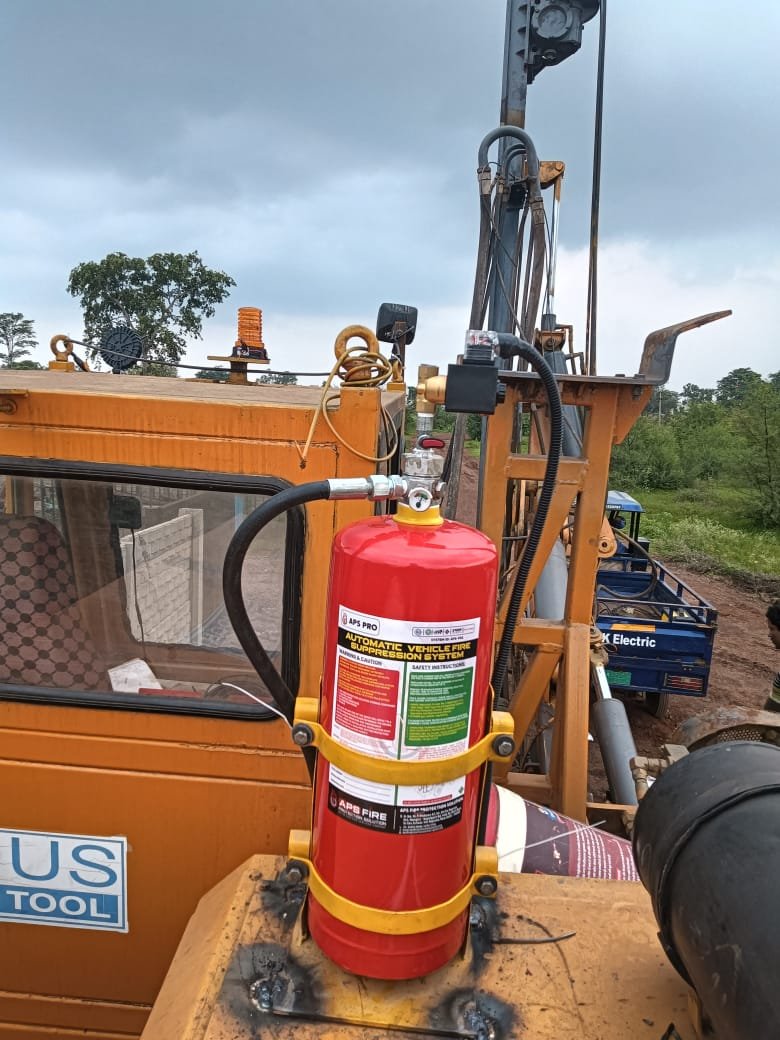
We start here deliberately. Vehicle Fire Suppression System is the most technically demanding, most frequently neglected, and — in the Indian context — one of the most urgently needed types of fire protection available.
India operates one of the largest fleets of heavy earth-moving machinery (HEMM) in Asia. Coal mines in Jharkhand, Chhattisgarh, Odisha, and Madhya Pradesh run hundreds of dumpers, excavators, dozers, and drill machines around the clock. Construction sites across the country deploy loaders, backhoes, and cranes in conditions of extreme dust, heat, and mechanical stress. Logistics and transport fleets cover lakhs of kilometres daily. Yet the adoption of automatic vehicle fire suppression systems in India remains well below what the risk profile demands.
A vehicle fire — particularly in a heavy machine — develops in seconds. The engine compartment of a 120-tonne mining dumper contains diesel fuel, engine oil, hydraulic fluid, and turbocharger surfaces running above 600°C. A ruptured hydraulic hose spraying fluid onto a turbocharger can ignite a fire that engulfs the entire cab area within 90 seconds. Portable fire extinguishers, the most common "protection" on Indian mining sites, are designed for small, early-stage fires and require a person to be present, aware, and trained. They offer almost no realistic protection against an engine compartment fire on a large HEMM vehicle.
How a Vehicle Fire Suppression System Works
A properly engineered automatic vehicle fire suppression system monitors the most fire-prone zones of the vehicle continuously and discharges a suppression agent the moment a fire is detected — without any input from the operator.
The detection system typically uses one of two technologies. Linear heat detection cable is routed through the engine compartment, hydraulic bay, and wheel arch areas. It is a fixed-temperature digital sensor that initiates an alarm when its rated activation temperature — commonly 180°C for Indian mining HEMM applications — is reached along any point of its length. The second detection method is polymeric detection tubing, a pressurised hollow tube routed directly near fire hazard points. When exposed to flame or extreme heat (typically 110°C–150°C), the tube bursts at the hottest point, and the pressure differential triggers agent discharge directly at the fire source. This second method is entirely power-free, which makes it especially reliable in the harsh electrical environments of heavy vehicles.
On alarm confirmation, a solenoid valve or burst disc releases pressurised nitrogen from a pilot cylinder, which in turn forces the suppression agent out through a delivery network of stainless steel pipes and nozzles positioned directly over the fire hazard zones. The entire activation sequence — from detection to full agent discharge — typically completes in under 30 seconds. Simultaneously, the system triggers the cab alarm, cuts engine ignition if wired to do so, and activates any external warning strobes.
Suppression Agents Used in Vehicle Systems
Dry Chemical Powder (DCP): Monoammonium phosphate or potassium bicarbonate powder discharged under nitrogen pressure. Effective on Class A, B, and C fires. The most widely used agent in Indian HEMM suppression systems because of its cost-effectiveness, reliability across wide temperature ranges, and proven performance on fuel, oil, and electrical fires. The post-discharge residue requires cleanup but causes no permanent damage to vehicle components.
Twin-Agent (Foam + DCP): A combination system that discharges dry chemical powder to knock down the fire rapidly, followed by a light water or AFFF foam application to prevent re-ignition. This is considered best practice for protecting fuel-heavy environments like mining dumpers and heavy-duty trucks, where re-ignition risk from residual heat is significant. DGMS (Director General of Mines Safety) guidelines in India recognise twin-agent systems for HEMM protection.
Clean Agent (FM-200 / Novec 1230): Used in vehicle suppression where the operator cab or passenger compartment requires protection. These agents are electrically non-conductive, leave no residue, and are safe for human exposure at design concentrations. They are more expensive than DCP but are the preferred choice for passenger-carrying buses, airport ground support equipment, and vehicles where clean-up and equipment preservation are priorities.
Wet Chemical Agent: Occasionally used in specialised vehicle applications involving cooking or food transport, but rare in standard vehicle suppression contexts.
Where Vehicle Fire Suppression Systems Are Mandated in India
DGMS Circular No. 6 of 2020 specifically mandates Automatic Fire Detection and Suppression Systems (AFDSS) for all HEMM vehicles operating in Indian mines — including dumpers, dozers, drill machines, shovels, and excavators. This is a legally enforceable requirement under the Mines Act. Mining companies found operating HEMM without compliant AFDSS systems face inspection notices, stop-work orders, and liability in the event of an incident.
Beyond mines, the CMVR (Central Motor Vehicles Rules) amendments and AIS-135 standards address fire safety requirements for buses and passenger vehicles. Many fleet operators in the intercity and school bus segments are now installing Vehicle Fire Suppression System proactively as insurance requirements tighten and FSSAI, ARTO, and state RTO compliance frameworks evolve.
Which Vehicles Need a Fire Suppression System in India
Mining HEMM — dumpers, dozers, excavators, loaders, drills, and shovels — are the highest-priority application. Engine compartment fires on these machines are frequent, serious, and frequently fatal when unprotected. The combination of diesel engines, high-pressure hydraulic systems, and extreme heat makes them among the most fire-prone environments in any industry.
Construction equipment — cranes, concrete pumps, tower cranes, piling rigs — faces similar risk profiles and increasingly sees vehicle suppression systems as part of project safety requirements under IS 875 and related construction safety norms.
Fleet buses, intercity coaches, and school buses are a growing segment. A bus engine fire without suppression can go from ignition to full-cab fire in under three minutes. Several state-level bus operators and private coaches running in Tamil Nadu, Kerala, Maharashtra, and Karnataka have already mandated suppression systems following high-profile incidents.
Industrial forklifts, reach trucks, and warehouse material-handling equipment operate in enclosed spaces where a vehicle fire rapidly becomes a building fire. Propane-powered and lithium battery electric forklifts have significantly different fire risk profiles that require careful agent selection.
Defence vehicles, airport ground support equipment, fire tenders, and armoured personnel carriers all carry specific vehicle suppression requirements under their respective procurement and operational standards.
At APS Fire Protection Solutions, vehicle fire suppression is our deepest area of expertise. We design systems to DGMS, NFPA 17, NFPA 2001, and AIS standards, supply PESO-approved cylinders, and provide on-site installation and annual AMC servicing for HEMM fleets, bus operators, and industrial vehicle fleets across India.
Automatic Sprinkler Systems
The automatic sprinkler system is the most widely installed and most widely misunderstood type of fire suppression system in India. It is the workhorse of commercial, residential, and industrial fire protection — and when correctly designed, hydraulically calculated, and properly maintained, it is extraordinarily effective.
A sprinkler system consists of a network of pressurised pipes connected to a water supply, with individual sprinkler heads installed at regular intervals across a protected area. Each sprinkler head contains a heat-sensitive glass bulb filled with glycerin-based liquid. When the ambient temperature at that specific head reaches its rated activation temperature — typically 57°C, 68°C, or 79°C depending on the application — the liquid expands, the bulb shatters, and the head opens to discharge water in a specific pattern and flow rate.
The most persistent myth about sprinkler systems is that all heads activate simultaneously when any one head is triggered. This is categorically false. Only the head or heads directly exposed to the fire zone activate. In a typical office building fire, statistical data consistently shows that 60–70% of fires are controlled by a single sprinkler head. This targeted activation minimises water damage to areas unaffected by the fire — a significant concern in Indian commercial and residential buildings.
Wet Pipe Sprinkler Systems
In a wet pipe system, the pipes are permanently filled with water under pressure. This is the simplest, fastest-responding, and lowest-maintenance variant of sprinkler system. The moment a sprinkler head activates, water is immediately available at that point. No additional valve needs to open, no pneumatic or electronic signal needs to travel through the system. Response time is essentially instantaneous.
Wet pipe systems are the standard choice for Indian offices, shopping malls, IT parks, hotels, hospitals, residential high-rises, and commercial warehouses operating at normal ambient temperatures. IS 15105:2002 governs the design and installation of fixed automatic sprinkler systems in India, and NBC 2016 Part 4 specifies the building types and heights that require automatic sprinkler installation. In most major Indian cities, buildings above 24 metres height require automatic sprinkler protection under their state-level adoption of NBC norms.
The fire pump set is a critical component of any wet pipe system. NBC 2016 mandates a minimum residual pressure of 3.5 kg/cm² at the hydraulically most remote sprinkler head, which drives the pump sizing calculation. The standard configuration for Indian commercial buildings is an electric main pump, a diesel-driven standby pump, and a jockey pump — the last of which maintains system pressure and detects small leaks without triggering the main pumps unnecessarily.
Dry Pipe Sprinkler Systems
In environments where pipes could freeze — cold storage facilities, refrigerated warehouses, unheated industrial sheds in North India's winter — a dry pipe system is used instead. The pipes are filled with pressurised air or nitrogen rather than water. When a sprinkler head activates, the air pressure drops, a dry pipe valve opens, and water rushes in to fill the pipes before discharging at the open head.
The response time in a dry pipe system is slower than wet pipe because of the time required to expel air and fill the pipes with water. This is a known design consideration — dry pipe systems are typically limited in pipe volume to limit this delay. In Indian contexts, dry pipe systems also see use in areas where even a small accidental leak of water would cause significant damage, such as certain electronics manufacturing areas or archival document storage where a clean agent system cannot be justified.
Pre-Action Sprinkler Systems
A pre-action system adds an electronic detection step before water is admitted to the pipes. The system requires two independent events to occur before water discharges: the electronic fire detection system must detect a fire and open a pre-action valve, and then a sprinkler head must also activate by heat. This double-confirmation mechanism virtually eliminates the risk of accidental water discharge from a mechanically damaged sprinkler head.
Pre-action systems are specified in environments where even a small accidental water discharge would cause serious damage — data centres with water tolerance, museums, critical care units in hospitals, and computer rooms where clean agent systems are not feasible. They are more complex and expensive than wet or dry pipe systems but represent the right solution where asset protection from accidental activation is a genuine concern.
Deluge Systems
A deluge system is the most aggressive water-based fire suppression option. All sprinkler heads are open (not heat-sensitive), and the supply water is held back by a deluge valve that opens on a signal from the detection system. When the valve opens, water floods every nozzle in the protected zone simultaneously.
Deluge systems are specified for extremely high fire hazard environments where speed of suppression is paramount and the risk is severe enough to justify wetting the entire area. In India, deluge systems are found in transformer rooms and switchgear bays of power plants, aircraft hangars, flammable liquid storage warehouses, paint spray booths, and certain industrial chemical process areas.
APS Fire Protection Solutions designs and installs IS 15105-compliant sprinkler systems for commercial, industrial, and residential projects across India. We handle hydraulic calculations, fire pump sizing, material selection, NOC drawings, and post-installation commissioning.
Water Mist Fire Suppression Systems
Water mist systems are among the most technically sophisticated fire suppression solutions available and are gaining meaningful traction in India's high-end hospitality, healthcare, heritage building, and data centre sectors. They work on a fundamentally different principle from conventional sprinklers, despite also using water as the primary agent.
Rather than discharging large-droplet water from conventional sprinkler heads, water mist systems atomise water into extremely fine droplets — classified as Class 1 (under 100 microns), Class 2 (100–400 microns), or Class 3 (400–1,000 microns). These micron-scale droplets have a dramatically higher surface area relative to their volume compared to conventional water droplets. When they enter a fire zone, they flash-evaporate rapidly, absorbing enormous amounts of heat (steam takes roughly 7 times more energy to produce from water than water takes to reach boiling point). This rapid evaporation also displaces oxygen in the immediate fire zone. The combined effect — rapid cooling plus localised oxygen displacement — suppresses the fire faster and with a fraction of the water volume of a traditional sprinkler system.
A water mist system uses up to 90% less water than a conventional sprinkler system for equivalent fire suppression performance. In a country where water availability is a genuine concern — and where secondary water damage to furnishings, electronics, and building finishes is a major cost after any sprinkler activation — this is a meaningful practical advantage.
Water mist systems are specified in Indian five-star hotels and luxury resorts where the cost of interior damage from a conventional sprinkler activation would be enormous. They are increasingly used in hospitals, particularly in ICUs and operating theatres where conventional sprinkler activation would be clinically disastrous. Heritage buildings under the Archaeological Survey of India's protection, where conventional sprinkler installation is either technically difficult or legally restricted, represent another important application. Marine applications — on passenger vessels, ferries, and cargo ships operating in Indian coastal and inland waterway trade — also represent a significant and growing use case.
The primary limitation of water mist systems is their higher capital cost relative to conventional sprinklers, more demanding maintenance requirements (nozzles operate at very high pressures — up to 100 bar in high-pressure systems — and require specialist servicing), and the fact that certain Class B and Class C fire risks require additional agents for full suppression efficacy.
Clean Agent Gas Fire Suppression Systems
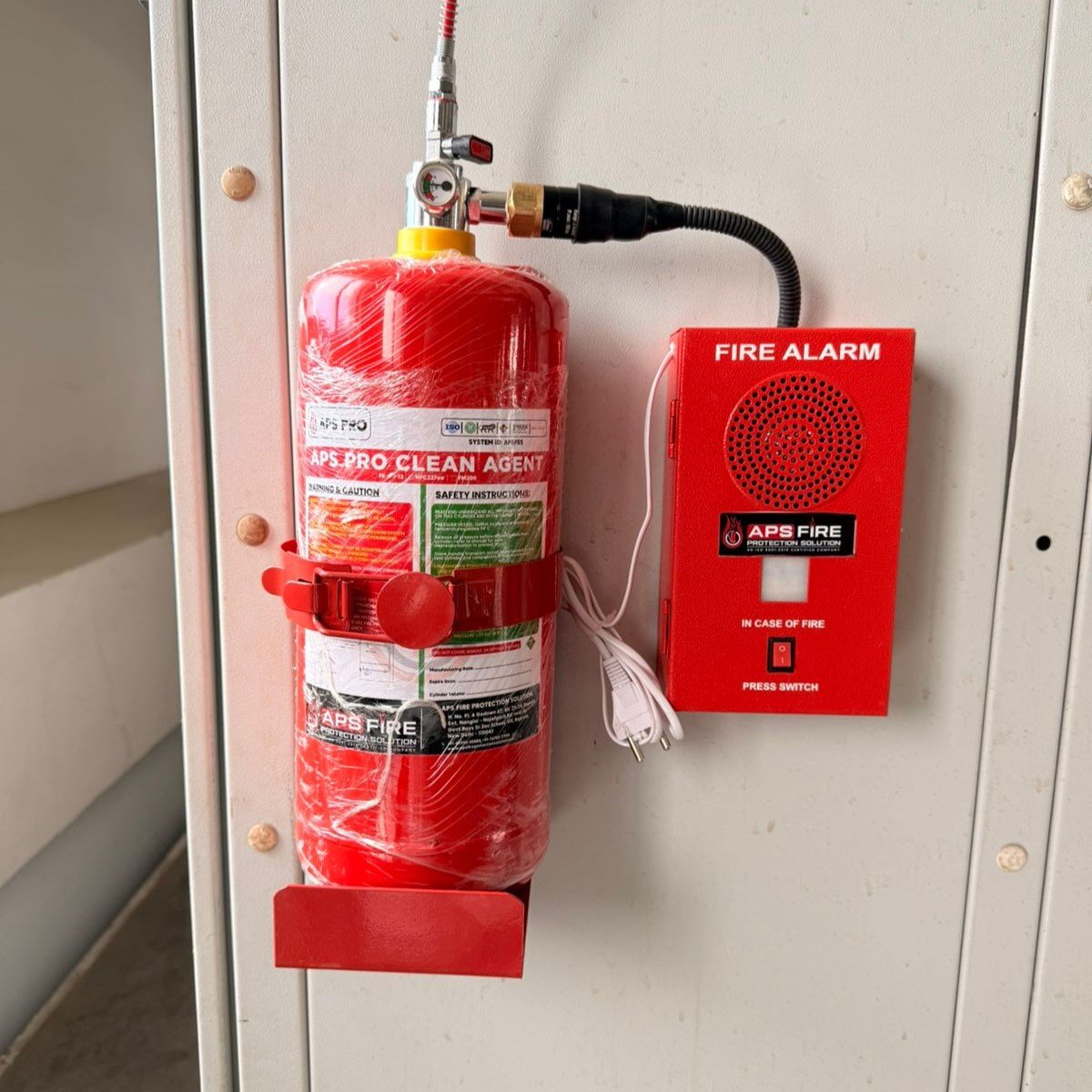
Clean Agent Fire Suppression System are the definitive choice whenever you need to protect sensitive electronics, irreplaceable assets, or occupied spaces from fire without causing water damage or leaving residue. They are the most common type of fire suppression system in Indian data centres, server rooms, telecom exchanges, bank vaults, control rooms, and switchgear rooms.
The term "clean agent" refers to the fact that these gases discharge, suppress the fire, and then evaporate completely — leaving no residue whatsoever on protected equipment, documents, or surfaces. There is no post-discharge cleanup. A server room can be re-entered, ventilated, and returned to full operation within hours of a clean agent discharge, compared to days or weeks for a water-damaged facility.
All clean agent systems operate on the principle of total flooding. The agent fills the entire protected enclosure to a design concentration — typically 6–9% by volume of the room — sufficient to suppress all fire activity throughout the space. This requires that the room be effectively sealed to hold the agent at design concentration for a dwell time (typically 10 minutes) sufficient to ensure the fire cannot re-ignite. Room integrity testing, which measures the leakage rate of a protected enclosure, is therefore a mandatory pre-commissioning step for all clean agent installations in India.
FM-200 (HFC-227ea)
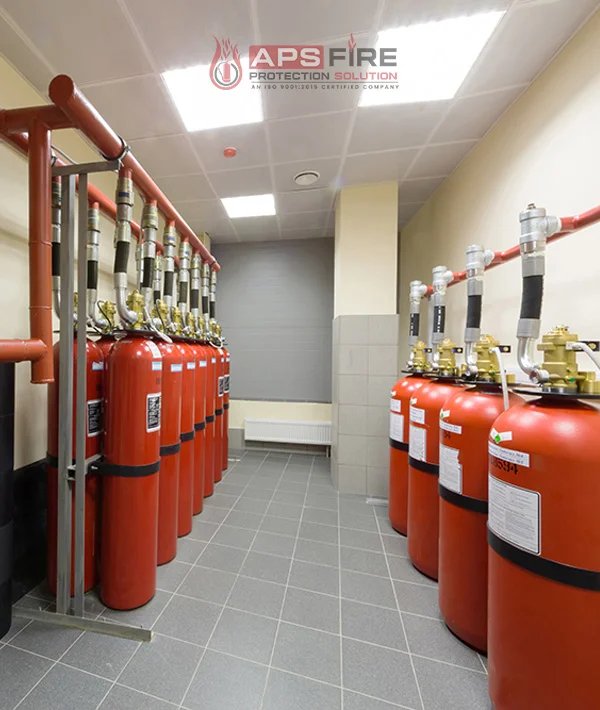
FM-200 Fire Suppression System is the most widely installed clean agent in India and remains the dominant choice for new server room and data centre suppression installations across the country. It is stored as a liquefied gas at approximately 25 bar pressure and discharges as a vapour within 10 seconds of system activation. It is electrically non-conductive and certified safe for human exposure at its design concentration of approximately 7–8% by volume.
FM-200 suppresses fire primarily through heat absorption — the agent molecules absorb and carry away heat at the molecular level, interrupting the combustion chain reaction. It is effective on Class A, B, and C fires. Honeywell, Minimax, and Ceasefire are among the brands offering FM-200 systems with PESO-approved cylinders and UL-listed components in the Indian market. APS Fire Protection Solutions installs FM-200 systems compliant with NFPA 2001 and IS standards across server room, control room, and heritage protection applications.
Novec 1230 (FK-5-1-12)
Novec 1230, originally developed by 3M (now Chemours), is the most environmentally advanced clean agent currently commercially available. Its atmospheric lifetime is approximately 5 days — compared to around 31–36 years for FM-200. Its Global Warming Potential (GWP) is 1, compared to FM-200's GWP of 3,220. For organisations with ESG commitments, green building certifications (IGBC, GRIHA, LEED), or environmental compliance requirements, Novec 1230 is the specified agent for new installations.
Novec 1230 operates at lower storage pressure than FM-200, reducing the structural requirements on the cylinder room and reducing the noise of discharge — relevant in noise-sensitive environments like broadcasting studios or financial trading floors. It provides equivalent fire suppression performance to FM-200 and carries the same human safety profile. The primary difference is cost — Novec 1230 agent is more expensive per kilogram than FM-200, and refilling after a discharge costs more. However, for organisations targeting long-term compliance with increasingly stringent environmental regulations on fluorinated gases, the investment premium is justified.
Inert Gas Systems — IG-541, IG-55, IG-100
Inert gas systems use naturally occurring, non-synthetic gases — typically argon, nitrogen, or a blend of both with a small CO2 component — to suppress fires by reducing the oxygen concentration in the protected space from the normal atmospheric 21% to approximately 12.5%. At this concentration, flaming combustion cannot sustain itself, yet human beings can remain conscious and functional (though evacuation is always required).
Inert gas systems carry a GWP of zero and zero ozone depletion potential. They are the most environmentally benign of all total-flooding fire suppression options. Their principal limitation is the large cylinder bank required to hold sufficient gas volume for a typical room — inert gas systems require significantly more storage space than equivalent FM-200 or Novec 1230 systems for the same protected volume, because inert gases cannot be liquefied and stored at anywhere near the density of halon replacement agents.
In India, inert gas systems are specified for archive and record storage rooms, museum vaults, historical document repositories, and certain large industrial control rooms where the environmental footprint of a synthetic agent is unacceptable and cylinder storage space is available.
CO2 Fire Suppression Systems
Carbon dioxide at suppression concentrations (typically 34–75% by volume depending on the fuel) is lethal to human beings. This is not a design flaw — it is the physical reality of how CO2 suppresses fires, by displacing oxygen below the level that sustains both combustion and human life. CO2 systems are therefore only specified for normally unoccupied, sealed spaces where the risk of human presence during discharge is controlled through strict lock-out and pre-discharge alarm procedures.
The applications in India are specific: cable tunnels and trunking vaults in power stations, enclosed turbine basements, unmanned electrical transformer rooms, printing press roller systems, and certain industrial equipment enclosures. CO2 is exceptionally effective, leaves no residue, and is relatively low cost compared to other clean agents. The engineer's responsibility is absolute rigour in ensuring human exclusion during and after discharge.
Wet Chemical Kitchen Fire Suppression Systems
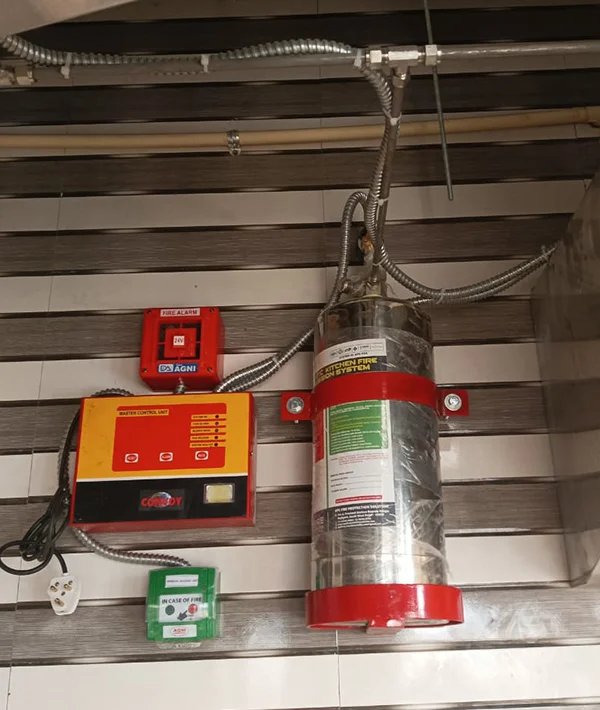
India's food service industry is enormous. There are millions of restaurants, hotels, dhabas, cloud kitchens, canteens, and food processing facilities across the country. A significant proportion of them cook with open flames and large quantities of vegetable oils, ghee, and fats at temperatures between 180°C and 230°C. These conditions create a fire risk that is categorically different from almost any other built environment.
When cooking oil overheats — through a thermostat failure, an unattended fryer, or excessive loading — it reaches its auto-ignition point (typically around 340°C–360°C for refined vegetable oil). The resulting fire is self-sustaining, extremely hot, and critically dangerous if treated incorrectly. Applying water to a burning oil fire causes a violent flash steam explosion — the water vaporises instantaneously beneath the oil surface, throwing burning oil droplets in all directions. A conventional sprinkler system activating over a deep fryer fire can turn a kitchen incident into a disaster.
A Wet Chemical Kitchen Fire Suppression Systems is specifically engineered to address this risk. The wet chemical agent — a potassium-based alkaline solution, typically potassium citrate, potassium acetate, or potassium carbonate — reacts with hot oil through a chemical process called saponification. When the agent contacts the superheated oil, it forms a thick, soapy, foam-like layer on the oil surface. This layer does two things simultaneously: it seals the oil from atmospheric oxygen, cutting off the fire's oxygen supply; and it rapidly cools the oil surface below its re-ignition temperature. The reaction is self-perpetuating once initiated — the saponified layer continues to cool and seal the oil even as the nozzles stop discharging.
The system is installed with nozzles positioned inside the kitchen exhaust hood and directly over each cooking appliance. Detection is provided by heat-sensitive detection tubing routed through the hood, or by linear heat detection cable, which triggers the system automatically when flame or extreme heat is detected. Critically, the system is also wired to a gas isolation valve that automatically shuts off the LPG, CNG, or piped gas supply to all cooking appliances on activation — removing the fuel source entirely.
In India, wet chemical kitchen suppression systems are engineered and installed to NFPA 17A (Standard for Wet Chemical Extinguishing Systems) and UL 300 (Standard for Fire Testing of Fire Extinguishing Systems for Commercial Cooking Equipment) standards. The NBC 2016 requirement for commercial kitchens in hotels, hospitals, and large institutions to have appropriate fire suppression makes these systems a compliance necessity in addition to a practical safety investment.
APS Fire Protection Solutions installs wet chemical kitchen suppression systems for hotels, restaurant chains, hospital kitchens, institutional canteens, and cloud kitchens. Our systems include automatic gas shutoff integration, semi-annual maintenance under AMC, and full NOC documentation support.
Foam Fire Suppression Systems
Foam systems are the technology of choice for large-scale Class B fire risks involving pools and spills of flammable liquids. They are engineered for scenarios where the sheer volume of flammable material, or the rate at which it can spread, makes any other suppression approach inadequate.
The fundamental working principle of a foam system is surface blanketing. Foam — a mass of air-filled bubbles generated by mixing water, foam concentrate, and air — flows across the burning fuel surface and forms a cohesive blanket. This blanket works through two complementary mechanisms: it physically separates the fuel from atmospheric oxygen by covering the surface, and it suppresses vapour release from the fuel by cooling the liquid surface and sealing it from the heat above. A stable, coherent foam blanket that covers the entire fuel surface completely will extinguish the fire and prevent re-ignition as long as the blanket remains intact.
AFFF — Aqueous Film Forming Foam
AFFF is the most widely used foam concentrate in Indian industrial applications. It produces a watery aqueous film beneath the foam blanket that flows ahead of the foam across the fuel surface — allowing AFFF to spread and seal burning liquid rapidly, even before the foam body fully covers the area. AFFF is specified for aviation fuel farms, petroleum storage tank farms, fuel dispensing areas, and industrial process areas handling flammable liquid hydrocarbons.
The environmental profile of AFFF has become a significant issue in India as it has globally. AFFF concentrates containing PFAS (per- and polyfluoroalkyl substances — the class of chemicals colloquially known as "forever chemicals") are now subject to regulatory scrutiny. Indian environmental regulators and BIS are developing position papers on PFAS in fire suppression agents, following international moves by the EU and US EPA. Progressive Indian industrial operators are proactively evaluating PFAS-free AFFF alternatives (fluorine-free foams, or FFF) for new installations. This is an area to discuss specifically with your fire suppression consultant if you are planning a new foam system.
Alcohol-Resistant AFFF (AR-AFFF)
Standard AFFF foams are quickly destroyed when they contact water-soluble (polar) flammable liquids like alcohols, ketones, acetone, and ethanol. AR-AFFF foams contain a polymeric additive that forms a protective membrane on the foam surface when it contacts polar fuels, preventing dissolution. AR-AFFF is specified for pharmaceutical manufacturing areas, chemical processing plants, solvent storage, and distillery operations — all significant sectors in India.
High-Expansion Foam
High-expansion foam systems generate foam at expansion ratios of 200:1 to 1,000:1 — meaning a small volume of solution produces an enormous volume of foam. This property makes high-expansion foam uniquely suited to filling large enclosed volumes rapidly — underground mine tunnels, ship holds, enclosed aircraft hangar areas, and deep basement car parks. In India, IS 12349 covers high expansion foam generators. Coal mine fire suppression is an application where high-expansion foam systems are specified under DGMS guidelines for certain underground operations.
Dry Chemical Powder (DCP) Fire Suppression Systems
Dry chemical powder suppression systems are among the most versatile fire suppression tools available, capable of tackling Class A, B, and C fires rapidly and effectively. The extinguishing mechanism is primarily chemical — fine powder particles interrupt the combustion chain reaction at the molecular level, disrupting the flame's self-sustaining chemistry faster than any purely physical suppression method.
The two most common DCP agents in Indian applications are monoammonium phosphate (MAP) powder, which is effective on Class A, B, and C fires and is the agent in standard ABC powder extinguishers; and sodium bicarbonate or potassium bicarbonate powder, which is particularly effective on Class B and C fires and is preferred for certain commercial cooking and industrial applications where MAP powder's corrosivity is a concern.
Fixed DCP suppression systems in India are found in LPG storage and bottling facilities, industrial gas cylinder banks, CNG vehicle refuelling stations, welding and cutting areas, paint booths, transformer rooms (where the electrical non-conductivity of dry powder is a specific advantage), and heavy vehicle engine bays as discussed above in the vehicle suppression section.
The principal limitation of fixed DCP systems is post-discharge cleanup. Dry chemical powder is corrosive over time and will damage electronic components, contaminate food, and require thorough cleaning of machinery and surfaces before normal operations can resume. For this reason, DCP systems are not appropriate for data centres, server rooms, laboratories, clean rooms, or food processing areas — clean agent gas systems are the right choice for those environments. DCP is at its best in industrial and outdoor environments where equipment robustness and fire suppression speed outweigh the cleanup consideration.
Tube-Based (Linear Detection Tube) Fire Suppression Systems
Tube-based suppression systems deserve particular attention because they represent a category that is rapidly growing in India but remains poorly understood by many building and equipment owners. They combine the detection and delivery functions into a single component — the detection tube itself.
A tube-based system uses a flexible, pressurised polymer tube that is routed directly through the protected space — inside an electrical panel, through a vehicle engine bay, inside a CNC machine enclosure, or through a battery storage cabinet. The tube is filled with suppression agent under pressure. When fire or extreme heat contacts the tube, it ruptures at the hottest point, and the suppression agent discharges directly at the fire source through the rupture point, simultaneously with any connected nozzles.
There are two variants. In a direct discharge system, the tube itself acts as both detector and delivery nozzle — the agent escapes through the rupture and floods the protected enclosure. This is the simplest variant and is widely used for protecting small enclosed spaces: electrical distribution panels, CNC machine housings, generator control panels, small server cabinets, and vehicle engine bays on light vehicles and buses. In an indirect discharge system, the tube detects the fire and signals a separate cylinder of suppression agent, which then discharges through conventional nozzle networks. This allows a larger agent payload for bigger protected volumes.
Tube-based systems are power-free in their most basic direct-discharge variant — no electricity, no control panel, no wiring. This makes them exceptionally reliable in harsh electrical environments and suitable for remote or unmanned locations where power supply reliability is questionable. In India, they are increasingly specified for electrical panel protection in factories and substations, vehicle engine bay protection on buses and construction equipment, battery storage protection (including lithium battery packs in EVs and energy storage systems), and small server cabinet protection in branch offices and retail locations.
APS Fire Protection Solutions supplies and installs tube-based detection and suppression systems for electrical panels, CNC machines, vehicle engine bays, and battery storage applications. We use PESO-approved cylinders and provide certification documentation for insurance and inspection purposes.
Aerosol Fire Suppression Systems
Condensed aerosol systems are a relatively newer addition to the Indian fire suppression market and occupy a specific niche that is worth understanding. Rather than storing a liquid or gaseous agent in pressurised cylinders, aerosol systems contain a solid pyrotechnic compound — typically a potassium salt mixture — that when ignited generates a dense cloud of fine solid and gaseous particles. These particles suppress fire through a combination of chemical chain reaction interruption (similar to dry powder) and some oxygen displacement.
The key advantage of aerosol systems is that they contain no pressurised vessel. They require no cylinder storage room, no high-pressure pipework, and no complex filling or maintenance infrastructure. The units are compact, self-contained, and can be mounted directly inside the protected enclosure. Activation can be automatic (via a detection system signal) or thermal (built-in fusible link that triggers at a preset temperature).
Aerosol systems are finding application in Indian contexts for protecting electrical enclosures, control cabinets, telecommunications equipment rooms, and vehicle engine bays where the installation space and infrastructure for a conventional gas system are not available. They are not appropriate for occupied spaces (the aerosol cloud is an irritant and should not be breathed), large open volumes, or environments with significant airflow that would disperse the aerosol before it reaches suppression concentration.
Hydrant Systems — A Note on Terminology
When discussing types of fire suppression systems in India, it is common for building owners and safety officers to conflate fire hydrant systems with fire suppression systems. They are related but distinct.
A fire hydrant system is a water supply infrastructure — pipes, risers, hydrant valves, and hose reels — that provides water at pressure to fire service personnel or trained building fire teams for manual fire fighting. It is an active fire protection component, but it requires human intervention to use. It does not detect fire, does not activate automatically, and does not suppress fire without a person directing the hose. The hydrant system is a tool for controlled manual fire fighting, not an automatic suppression system.
Automatic fire suppression systems — sprinklers, clean agents, vehicle suppression, kitchen systems — detect and suppress fire without human intervention. The two categories complement each other and both are typically required in large commercial and industrial buildings under NBC 2016. A complete fire protection strategy for most Indian commercial buildings includes both an automatic suppression system (sprinklers or clean agent) and a manual hydrant system as backup.
How to Choose the Right Type of Fire Suppression System
Every genuine decision about fire suppression system type begins with the same question: what specific fire risk am I protecting against, and what is at stake?
If you manage a coal mine or an open-cast quarry, vehicle fire suppression for your HEMM fleet is not optional — it is a DGMS legal requirement, and the human cost of getting it wrong is incalculable. APS Fire Protection Solutions' vehicle suppression expertise makes us the natural partner for mining and heavy industry fleet protection.
If you run a restaurant, hotel kitchen, food court, or cloud kitchen, a wet chemical kitchen suppression system is the only correct solution for your cooking appliances. Standard sprinklers will not protect a Class F cooking oil fire adequately — and may make it worse.
If you have a server room, a data centre, a switchgear room, or a control room containing electronics, a clean agent system (FM-200 or Novec 1230 for new installations) is the appropriate choice. Water in any form — sprinkler or mist — should be avoided where the secondary damage from a discharge would be as catastrophic as the fire itself.
If you are building or operating a commercial building — an office, a mall, a hospital, a hotel, a warehouse — automatic wet pipe sprinklers are almost certainly required under NBC 2016 and your state fire department's NOC conditions, and they represent the correct primary protection for these environments.
If your building contains a transformer room, a paint booth, a flammable liquid store, or a generator room, a dedicated suppression system — foam, CO2, clean agent, or DCP depending on the specific risk — should be specified for those zones in addition to the general sprinkler coverage for the rest of the building.
And if your electrical panels, CNC machines, server cabinets, or battery storage units are unprotected, a tube-based or aerosol suppression unit provides simple, cost-effective, power-independent protection that can be installed in a day.
The right answer almost never comes from a catalogue. It comes from a site assessment by an experienced fire protection engineer who understands your specific building, your specific risk, and the Indian regulatory framework that applies to you. That is what every APS Fire Protection Solutions engagement starts with.
Summary — Types of Fire Suppression Systems at a Glance
Vehicle Fire Suppression Systems protect heavy earth-moving machinery, mining vehicles, buses, trucks, and industrial equipment from engine compartment fires using DCP, twin-agent, or clean agent discharge. Mandatory for HEMM under DGMS Circular 6 of 2020. APS Fire Protection Solutions' core specialisation.
Automatic Sprinkler Systems — wet pipe, dry pipe, pre-action, and deluge — provide water-based fire suppression for commercial, residential, and industrial buildings. Governed by IS 15105 and NBC 2016 Part 4. The most widely mandated system type for Indian buildings above 24 metres.
Water Mist Systems use ultra-fine water droplets for high-efficiency suppression with minimal water usage. Best for heritage buildings, luxury hotels, hospitals, marine applications, and high-value interior environments.
Clean Agent Gas Systems — FM-200, Novec 1230, inert gas, CO2 — provide zero-residue total flooding suppression for server rooms, data centres, switchgear rooms, bank vaults, and electronics-sensitive environments. Governed by NFPA 2001 and IS standards.
Wet Chemical Kitchen Suppression Systems use saponification chemistry to suppress Class F cooking oil fires in commercial kitchens. Governed by NFPA 17A and UL 300. Essential for hotels, restaurants, hospital kitchens, cloud kitchens, and canteens.
Foam Systems — AFFF, AR-AFFF, high-expansion — blanket flammable liquid surfaces to suppress Class B fires. Specified for petrochemical plants, fuel farms, aviation hangars, mine tunnels, and chemical processing facilities.
Dry Chemical Powder Systems provide rapid Class A, B, C fire suppression in industrial environments, LPG storage, gas cylinder bays, and vehicle engine bays where post-discharge residue is acceptable.
Tube-Based Suppression Systems use pressurised detection tubing as both sensor and delivery mechanism. Power-free, compact, and self-contained. Best for electrical panels, CNC machines, vehicle engine bays, battery cabinets, and small enclosures.
Aerosol Systems are compact, cylinder-free units for enclosed electrical equipment protection where conventional gas systems cannot be installed.
About APS Fire Protection Solutions
APS Fire Protection Solutions is a specialist fire suppression design, supply, installation, and maintenance company serving India. Our core expertise is in vehicle fire suppression for heavy vehicles, mining HEMM, and transport fleets — and we bring the same depth of technical knowledge to every type of suppression system we install.
We work to DGMS, NFPA, IS, and NBC standards. Every installation includes full documentation for fire NOC submission. Every client gets an Annual Maintenance Contract option to keep their system compliant, tested, and ready.
From a single kitchen suppression unit in a Pune restaurant to a multi-machine HEMM AFDSS installation at a Singrauli coal mine, from a data centre clean agent system in Bengaluru to a full sprinkler installation in a Mumbai high-rise — APS Fire Protection Solutions brings the same rigour to every project.
If you are evaluating fire suppression for any environment covered in this guide, we are ready to start with a no-obligation site assessment and an honest recommendation — not a sales pitch.