
Why Most Explanations of "How It Works" Are Completely Wrong
Search for "automatic fire suppression system how it works" and you will find roughly the same article written eight hundred different ways. Detect the fire. Open the valve. Release the agent. Three steps. Seven hundred words. Illustrated with a stock photo of a red cylinder.
That description is technically accurate in the same way that "press the pedal to go faster" accurately describes how a car engine works. It is true. It is also useless to anyone who needs to buy, specify, install, maintain, or explain one of these systems in a real building, on a real vehicle, or under a real compliance framework.
The actual working of an automatic fire suppression system involves chemistry that most explanations never touch, timing sequences that are measured in seconds and matter enormously, failure modes that no competitor page discusses, and an Indian regulatory context — NBC 2016, IS codes, DGMS guidelines, NFPA alignment — that is completely absent from every globally-written resource on this topic.
This guide fills every one of those gaps. It is written for the safety officer in a Bengaluru IT park evaluating a clean agent system for the server room, the plant manager in Pune whose factory insurer has asked for NBC 2016-compliant suppression documentation, the mine manager in Jharkhand whose HEMM fleet needs DGMS-compliant AFDSS installation, and the building developer in Mumbai whose project consultant has specified an automatic sprinkler system but has not explained why it will — or will not — work for every zone in the building.
By the end of this guide, you will understand exactly how an automatic fire suppression system works — not the three-step summary, but the full picture.
Start Here: The Fire Triangle and Why It Is Everything
Every automatic fire suppression system — regardless of type, size, agent, or application — works by attacking the fire triangle. Understanding the fire triangle is not optional background. It is the entire technical basis for why different suppression systems work the way they do, and why the wrong system for a specific fire risk fails completely.
Fire is a chemical chain reaction that requires three things simultaneously: fuel (any combustible material — wood, paper, diesel, cooking oil, electrical insulation), heat (enough to sustain the reaction — different fuels have different ignition temperatures), and oxygen (fire requires approximately 16% oxygen concentration to sustain; normal atmospheric air is 21%). Remove any one of these three elements and the fire stops.
A fourth element is increasingly added to modern fire science teaching: the uninhibited chemical chain reaction itself. Some suppression agents — particularly halon replacements like FM-200 and Novec 1230 — work by chemically interrupting the chain reaction at the molecular level, independently of whether they have physically removed fuel, heat, or oxygen. This is why the "fire tetrahedron" is a more accurate model than the triangle for understanding how modern clean agents work.
Every suppression agent attacks the fire at one or more of these four points:
Cooling (removing heat): Water is the most effective cooling agent available. One litre of water absorbs 2,257 kilojoules of energy when it vaporises — an enormous heat-absorbing capacity. Water mist systems use this property by dispersing water as ultra-fine droplets (under 1,000 microns) that vaporise almost instantly, absorbing heat from the fire zone faster than conventional sprinkler water can. This is why water mist suppresses fires with 90% less water volume than conventional sprinklers — not less water volume per litre, but less water needed because the heat transfer per litre is so much higher.
Smothering (removing oxygen): CO2 and inert gas systems work primarily by displacing oxygen. CO2 at a concentration of 34–75% (depending on the fuel) reduces ambient oxygen below the level at which combustion can sustain. Foam systems work by blanketing the fuel surface, physically sealing it from atmospheric oxygen. This is why foam is the correct agent for Class B (flammable liquid) fires — the burning liquid cannot re-ignite through the foam blanket as long as the blanket remains intact.
Fuel isolation (removing fuel): Wet chemical kitchen suppression systems work partly this way. When the potassium-based agent contacts superheated cooking oil, it reacts chemically through saponification — forming a soapy, foam-like layer on the oil surface that simultaneously seals the fuel from oxygen and prevents vapour release. The fuel is still present, but it is physically isolated from the fire.
Chemical chain interruption: FM-200 (HFC-227ea) and Novec 1230 (FK-5-1-12) suppress fires by releasing fluorine atoms that act as radical scavengers — they interrupt the specific chemical reactions within the flame that generate the heat and free radicals that sustain combustion. This mechanism is independent of oxygen concentration, which is why clean agents can suppress fires at relatively low concentrations (7–9% by volume) that are safe for humans to breathe. They do not need to displace enough oxygen to suffocate the fire — they stop the fire's chemistry directly.
Understanding which mechanism your suppression system uses tells you precisely which fire risks it is and is not suited for — and why matching the system to the fire class is the most important decision in fire protection design.
The Six Core Components of Every Automatic Fire Suppression System
Every automatic fire suppression system — whether it is a Rs. 55,000 DCP vehicle system or a Rs. 50-lakh clean agent data centre installation — is built around the same six functional components. The specific technology within each component changes. The functional role of each component does not.
Component 1: The Detection System
Detection is the starting point of everything. An automatic fire suppression system that cannot detect a fire reliably cannot protect anything. Detection quality — specifically how quickly it detects, how accurately it identifies a genuine fire versus a false alarm trigger, and how reliably it communicates that detection to the actuation system — determines the real-world performance of the entire installation.
India's fire suppression market uses five primary detection technologies, and the choice between them is not cosmetic. Each has specific strengths and weaknesses for specific environments.
Smoke detectors are the fastest detection technology for smouldering fires that produce smoke before flame. Ionisation smoke detectors are faster on fast-flaming fires; photoelectric (optical) smoke detectors are faster on slow-smouldering fires. IS 2189:2008 governs the selection, installation, and maintenance of automatic fire detection and alarm systems in India and specifies detector placement requirements for different room geometries and heights. In server rooms and data centres, aspirating smoke detection (ASD) systems — which actively draw air samples to a laser-based detector — can identify combustion particles at concentrations 100 times below the threshold at which a conventional point detector would alarm. This allows pre-alarm detection before a fire has visually developed, which is critical in rack-dense data centres where a smouldering cable fault needs to be identified before it becomes an open flame.
Heat detectors respond to temperature rise rather than smoke. Fixed-temperature heat detectors activate at a specific set point (typically 57°C, 68°C, or 79°C depending on the application and ambient temperature). Rate-of-rise detectors respond to a rapid temperature increase above a defined rate (typically 8°C per minute or more) and are effective at detecting fast-developing fires even if the ambient temperature has not yet reached the fixed-temperature threshold. Linear heat detection (LHD) cable — widely used in vehicle and tunnel applications — is a continuous cable sensor that activates at its rated temperature at any point along its routed length. This provides zone-coverage detection rather than point detection.
Flame detectors use infrared or ultraviolet sensors to identify the specific electromagnetic radiation wavelengths emitted by flames. They are effective in environments where smoke or heat detection would be unreliable — outdoor areas, high-ceiling industrial spaces, and environments with continuous background heat sources. Flame detectors have extremely fast response times and can detect fires across large open areas. Their limitation is that they require a line-of-sight view of the flame and can produce false alarms from certain artificial light sources.
Thermal detection tubing (polymer pressurised tubing — Firetrace, Amerex, BlazeCut, and similar brands) is a direct-acting detection method that combines detection and in some configurations delivery into a single component. The tube is routed directly through the fire hazard zone, filled with pressurised gas (typically nitrogen at 10–15 bar). When flame or extreme heat contacts the tube, the tube wall ruptures at the hottest point. This pressure drop either directly releases the suppression agent (direct system) or signals a separate cylinder to discharge (indirect system). No electricity, no control panel, no detector circuit — purely pneumatic. This is the correct choice for high-vibration environments (vehicle engine bays, CNC machines) where electrical fault rates make electronic detection systems less reliable.
Multi-sensor detectors combine smoke, heat, and sometimes CO sensing in a single unit, using algorithmic processing to reduce false alarm rates while maintaining fast genuine-alarm response. India's AIS-135 Amendment No. 2 (September 2023) specifically recommends multi-sensor detection for bus occupant compartment fire protection systems, based on DRDO CFEES research showing superior performance over single-sensor detection in bus fire scenarios.
Component 2: The Fire Alarm Control Panel (FACP)
The FACP is the brain of the suppression system. It receives signals from all detectors in the system, processes them according to its programmed logic, and decides when and how to initiate the suppression sequence. In a simple pre-engineered system (like a kitchen suppression installation or a vehicle engine bay system), the FACP may be a compact, single-zone control unit integrated with the suppression cylinder. In a large engineered system protecting a multi-floor commercial building or an industrial facility, the FACP may be an addressable panel managing hundreds of detector points across multiple protected zones, with sophisticated alarm logic, zone isolation, and event logging capabilities.
Modern FACPs in Indian commercial installations are required under IS 2189:2008 to have battery backup sufficient to maintain alarm and suppression control functions during a mains power failure — typically 24 hours standby followed by 30 minutes alarm operation. This is not optional backup — in India's power supply environment, a fire safety system that fails during a power cut is a fire safety system that fails when fire risk is elevated. Many industrial fires follow electrical faults, and electrical fault events are also when power supply reliability is most compromised.
A critical but often overlooked feature of a properly specified FACP is the distinction between single-detector activation and cross-zone confirmation before suppression discharge. In high-value environments — data centres, server rooms, archive vaults — a system that discharges agent on the signal from a single detector creates unacceptable false discharge risk. Water damage or clean agent discharge in a server room from a nuisance alarm is a significant operational event. Cross-zone logic — requiring confirmed signals from two independent detectors before discharge — is standard practice for these environments and is specifically referenced in NFPA 2001 (Standard on Clean Agent Fire Extinguishing Systems), which is widely followed for Indian data centre installations alongside the NBC 2016 framework.
Component 3: The Suppression Agent Storage System
The suppression agent is stored under pressure, ready for instant deployment. The storage configuration depends entirely on the agent type.
Water-based systems — sprinklers and water mist — store water in a pressurised pipe network (wet pipe) or in tanks fed through a valve (dry pipe, deluge). The pressure is maintained by the building's fire pump set — typically an electric main pump, a diesel standby pump, and a jockey pump that maintains pressure and detects small leaks. NBC 2016 Part 4 specifies a minimum residual pressure of 3.5 kg/cm² at the hydraulically most remote sprinkler head, which drives the pump sizing calculation for every Indian sprinkler installation.
Gas-based clean agent systems store the agent as a liquid under pressure in steel cylinders, typically at 25 bar or 42 bar depending on the system design. In India, all pressurised cylinders used in fire suppression systems must be PESO (Petroleum and Explosives Safety Organisation) approved — a specific Indian regulatory requirement that is not equivalent to CE marking or UL listing alone. PESO approval confirms that the cylinder has been manufactured, tested, and inspected under Indian regulatory oversight. Specifying or accepting a suppression system with non-PESO-approved cylinders in India creates legal compliance gaps regardless of what other international certifications the system carries.
Dry chemical powder systems store DCP under nitrogen pressure, typically at 10–15 bar. The nitrogen provides both the storage inert atmosphere (preventing moisture absorption into the powder, which causes caking) and the propellant pressure that drives agent through the pipe network to the nozzles on discharge.
Component 4: The Actuation Mechanism
Actuation is the bridge between detection and suppression — the mechanism by which the FACP's signal becomes actual agent release. This is the component that most frequently fails in real-world incidents, because it requires a signal pathway from the detection circuit to the agent storage to remain intact and functional under fire conditions — precisely when the environment around it is at its most hostile.
Electrical actuation uses a solenoid valve on the suppression cylinder. When the FACP sends a release signal, current flows through the solenoid, the valve opens, and the pressurised agent is released into the delivery network. This is the most common actuation method in commercial installations. Its dependency on electrical power and electrical circuit integrity is the critical design consideration — which is why battery backup on the FACP and robust cable routing away from fire risk zones are not installation niceties but functional requirements.
Pneumatic actuation uses a pressurised pilot cylinder. The FACP signal opens a small solenoid on the pilot cylinder, releasing a burst of nitrogen that physically opens the main agent valve. This two-stage approach allows a low-power solenoid to reliably control a much larger agent payload than a direct solenoid on the main cylinder would permit. It is the standard configuration for large HEMM vehicle suppression systems in Indian mining applications.
Mechanical actuation — using a physical pull-wire or cable — releases the suppression valve without any electrical signal. This is both the most reliable method in degraded electrical environments and the one that requires human action (or a specifically designed fusible link in the cable path) to initiate. On vehicle systems, mechanical activation provides an operator override capability — the driver can manually discharge the system from the cab. On older industrial equipment in Indian mines and construction sites, mechanical activation is the correct primary actuation method for retrofit installations where the vehicle's electrical system condition is unreliable.
Thermal tube activation (on detection tube systems) is fully autonomous — the tube pressure drop on rupture directly opens the agent valve without any electrical or mechanical signal from an external control system. This is the most reliable activation method available for enclosed, inaccessible hazard zones — electrical panels, engine bay nooks, sealed equipment enclosures — where wiring a conventional actuation system is impractical or unreliable.
Component 5: The Agent Delivery Network
The delivery network — pipes, fittings, nozzles, and in water-based systems the full hydraulic distribution tree — carries the suppression agent from storage to the fire zone. This component is where the gap between a paper-compliant system and a genuinely effective system most clearly shows itself.
Every nozzle in a suppression system has a defined coverage area, a specific required flow rate, and a specific minimum and maximum pressure range within which it performs to its rated specification. The hydraulic design of the pipe network must ensure that every nozzle receives agent within these parameters simultaneously during a discharge event. This requires engineering calculation — not estimation, not rule of thumb, not copy-paste from another project. IS 15105:2002 (for sprinklers) and NFPA 2001 (for clean agents) both mandate hydraulic calculation documentation as part of the design record for any suppression installation.
In India's suppression market, a significant proportion of budget-tier installations skip this calculation. A system installed without verified hydraulic design may have nozzles that are perfectly positioned according to the drawing but receive insufficient pressure to generate their rated spray pattern — or nozzles that receive too much pressure and over-atomise the agent beyond the protected zone. Either way, the fire zone does not receive the required agent concentration, and the system fails to suppress the fire it was installed to address.
For vehicle systems, the pipe material specification matters enormously. Copper, stainless steel, or high-quality reinforced rubber are the correct materials for vehicle suppression pipe networks that must survive thousands of hours of vibration, thermal cycling, and chemical exposure. Mild steel without adequate corrosion protection, or low-grade rubber hose, will develop leaks and failures within two to three years in mining or heavy construction environments.
Component 6: Alarm and Notification Devices
The notification layer — sounders, strobes, visual indicators, and remote signalling — is the component most easily underspecified in India because it is often treated as an afterthought to the suppression hardware. This is a serious error. A suppression system that activates but does not effectively alert occupants does not fulfil its life-safety function.
IS 2189:2008 specifies alarm volume requirements for different occupancy types. In industrial and manufacturing environments, where ambient noise levels during operations can reach 85–95 dB, an alarm sounder that meets only the minimum 65 dB requirement of a residential specification will not be audible. Vehicle cabin alarms on HEMM equipment must be specified to be heard above diesel engine noise and cab HVAC operation — 90–100 dB output at the driver position is the appropriate specification for Indian mining equipment.
Remote signalling to a central monitoring station — connecting the suppression system alarm to an offsite monitoring centre that can alert the fire brigade — is a requirement under NBC 2016 for certain building categories and is increasingly specified in insurance conditions for commercial and industrial properties. This is the layer that converts a local-alarm system into a monitored safety system, and its absence is one of the most common gaps in Indian suppression installations.
The Actual Activation Sequence — Second by Second
No competitor page covers this. Every real fire protection engineer knows that the activation sequence matters — not just whether the system activates, but when each event happens within that sequence and what the failure consequence is if any event is delayed or missed. Here is the actual timeline for a correctly designed automatic fire suppression system activation.
T = 0: Fire ignition
A fire starts. In an electrical panel, this may be a cable insulation fault that begins smouldering. In an engine bay, it is a fuel line rupture spraying diesel onto a turbocharger surface. In a commercial kitchen, it is cooking oil reaching auto-ignition temperature in an unattended fryer. The fire exists. The suppression system is unaware. The clock starts.
T + 3 to 30 seconds: Fire detection
Detection time depends entirely on the detector type and its distance from the fire source. An aspirating smoke detector can identify pre-combustion aerosol particles within 3–5 seconds of ignition of a smouldering fault. A standard point smoke detector in the ceiling above a server rack will typically alarm at T + 10–30 seconds depending on ceiling height, room airflow, and the specific combustion chemistry of the fire source. A fixed-temperature heat detector will not alarm until the air temperature at its location reaches its set point — on a large open-plan factory floor, this may take several minutes after a fire starts in a low corner. A thermal tube in direct contact with the fire source activates at T + 2–5 seconds.
The gap between fire start and detection is where fires grow — and fire growth rate in unconfined conditions approximately doubles in energy output every 30–60 seconds in the critical early phase. A detection system that triggers at T + 3 seconds is responding to a fire with approximately 1/10th the energy of a detection system that triggers at T + 30 seconds. This is not a marginal difference — it is often the difference between a system that extinguishes the fire with a single nozzle's worth of agent and one that deploys its full charge and still struggles to overcome the fire load.
T + 30 to 60 seconds: FACP processing and pre-discharge alarm
The detector signal reaches the FACP. In a single-detector activation system, the FACP immediately initiates the alarm sequence. In a cross-zone system, the FACP waits for confirmation from a second detector before proceeding to discharge — typically with a 30–60 second confirmation window. During this window, the pre-discharge alarm sounds, giving occupants the signal to begin evacuation.
In India's building environment, the pre-discharge alarm sequence has a specific additional importance: many commercial and industrial buildings have occupants who are unfamiliar with automatic suppression systems and may not immediately understand the significance of an alarm. Clear, distinct pre-discharge alarm tones that differ from standard fire alarm tones — and building evacuation procedures that train occupants to evacuate immediately on any fire alarm without waiting to see visible fire — are critical life-safety elements that the suppression hardware alone cannot provide.
T + 60 to 90 seconds: Suppression agent discharge
The actuation mechanism releases the agent. For a properly designed system with adequate cylinder pressure, correctly sized nozzles, and a hydraulically verified pipe network, full agent delivery to all protected zones is complete within 7–15 seconds of valve opening for most pre-engineered systems. Clean agent systems specify a 10-second discharge time to design concentration under NFPA 2001. DCP systems for vehicles typically achieve full discharge in 7–10 seconds.
The suppression agent contacts the fire. Depending on the agent and the fire chemistry, suppression may be instantaneous (DCP on a Class B flaming fire), rapid (clean agent on an electrical fire), or graduated (foam on a large liquid spill fire, where total extinguishment follows foam blanket formation).
T + 2 to 10 minutes: Post-suppression holdtime
For gas-based total flooding systems, the agent concentration must be maintained at or above the minimum extinguishing level for a defined holdtime — typically 10 minutes under NFPA 2001. This holdtime is essential because it allows residual heat in the fire zone to dissipate below re-ignition temperature. A fire that is suppressed but re-ignites because the zone was ventilated before sufficient cooling has occurred is a system failure — even if the initial suppression was technically successful.
Room integrity — the ability of the protected enclosure to retain agent at design concentration for the full holdtime — is why door seals, cable penetration seals, and HVAC damper closure are integral parts of a clean agent system design. A room with unsealed cable trays and no HVAC damper interlock will not maintain the required holdtime regardless of how perfectly the detection and discharge elements performed.
Post-discharge: The events that most people miss
After discharge, a suppression system has done its job. What happens next determines whether the installation was a success or merely an incident with a delayed consequence.
For gas systems: the protected space must be ventilated before re-entry (CO2 and inert gas at suppression concentrations are immediately life-threatening; FM-200 and Novec 1230 at design concentration are safe but the combustion products in the space may not be). The fire cause must be identified and remediated before the area returns to service. The suppression system must be recharged and recommissioned by a qualified engineer before it is returned to operational status. A suppression system that has discharged but has not been recharged is a protected space with no suppression system — a fact that must be actively managed and communicated to the building's fire officer and insurer.
For DCP vehicle systems: all powder residue must be cleaned from electrical components, hydraulic connections, and mechanical surfaces before the vehicle is restarted. The fire cause — typically a ruptured hydraulic hose or fuel system fault — must be repaired. The suppression system must be recharged with a fresh agent charge, the pipe network inspected for integrity, the detection circuit tested, and the control unit reset and re-armed. A mine vehicle returned to operation after a suppression event without this full post-discharge process is a vehicle with both an unrepaired fire cause and a depleted suppression system — potentially the most dangerous configuration possible.
How Each Automatic Fire Suppression System Type Works — India Applications
Automatic Sprinkler Systems — How They Actually Work
The working principle of an automatic sprinkler system is simpler than any other suppression technology — and more frequently misunderstood. Each sprinkler head contains a heat-sensitive glass bulb filled with a glycerin-based liquid that expands when heated. When the air temperature at the sprinkler head reaches its rated activation temperature — 57°C for standard response heads in most Indian commercial applications — the liquid expansion shatters the bulb, the heat-sensitive element falls away, and the water supply pressure forces the deflector plate open, distributing water in the characteristic sprinkler spray pattern.
The widely repeated claim that "all sprinklers open at once" is false, and it is not a minor misconception — it affects how people understand the value of sprinkler systems. In a correctly designed sprinkler installation, only the head or heads directly in the fire plume activate. Statistical data from sprinkler performance records consistently shows that over 60% of fires in sprinklered buildings are controlled by a single sprinkler head. The water damage from a sprinkler activation affects only the fire zone, not the entire floor — which is why the argument "but the water damage will ruin everything" is usually made by people who have not seen a real sprinkler activation compared to the alternative.
Wet pipe sprinklers — with pipes permanently filled with pressurised water — are the correct choice for most Indian commercial and residential applications. Dry pipe systems — pipes filled with pressurised air, water admitted only on activation — are appropriate for cold storage environments and unheated spaces in North India where pipe freezing is a risk. Pre-action systems add an electronic detection confirmation step before water is admitted, providing additional protection against accidental discharge in high-value environments.
IS 15105:2002 governs sprinkler design and installation in India. NBC 2016 Part 4 specifies which building types and heights require automatic sprinklers — broadly, residential buildings above 24 metres, all hotels above a specified floor area, hospitals, multiplexes, and large commercial buildings. Most Indian states have adopted these requirements into their building bye-laws, making sprinkler installation effectively mandatory in most new commercial construction in major cities.
Clean Agent Gas Systems — How FM-200 and Novec 1230 Work
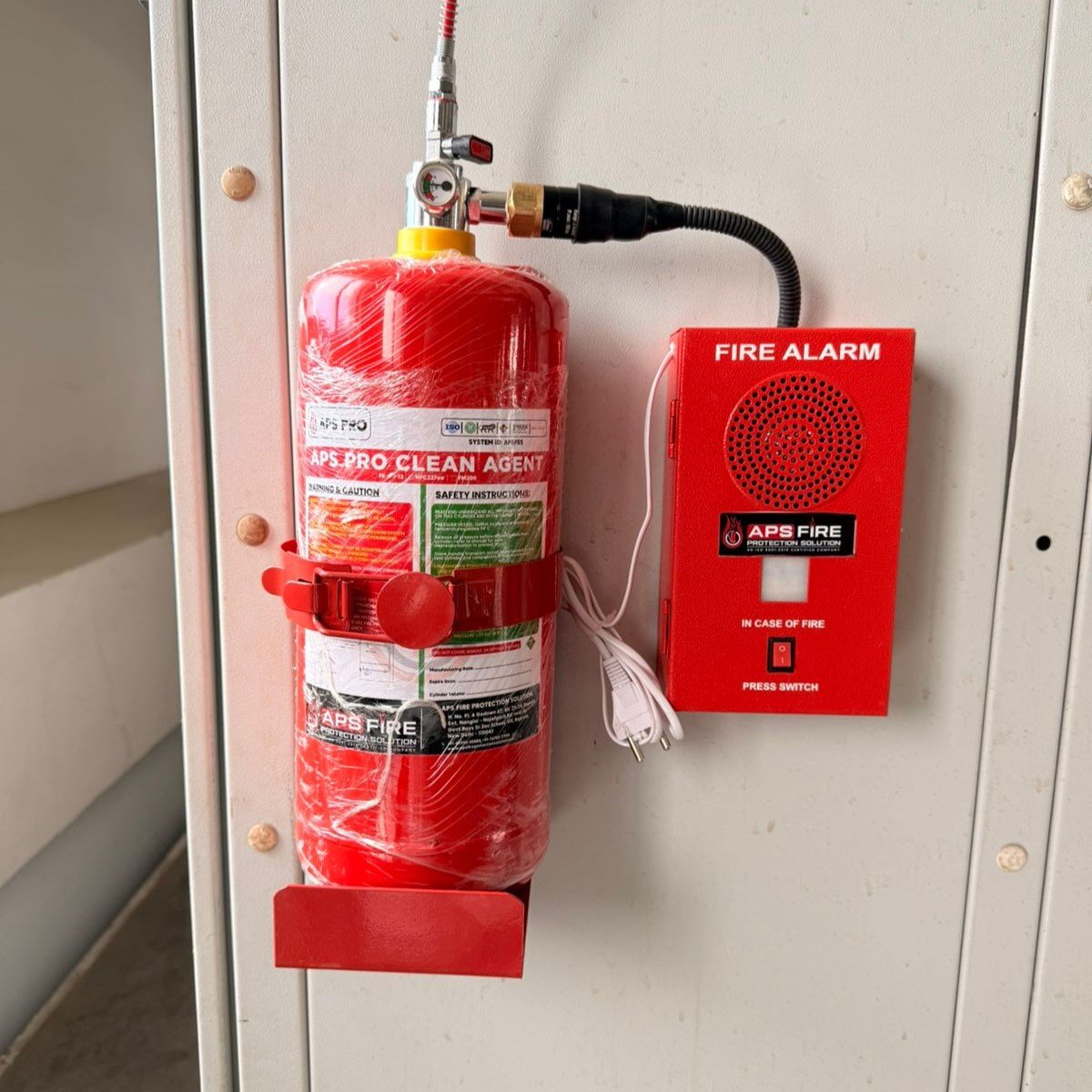
Clean agent systems — FM-200 (HFC-227ea), Novec 1230 (FK-5-1-12), and inert gas blends — are total flooding systems. The entire protected enclosure is flooded with agent to a design concentration sufficient to suppress fire throughout the volume. The system does not target a specific fire location — it treats the entire room as the suppression zone, which is why room integrity (sealed enclosure) is mandatory for system performance.
FM-200 suppresses fire primarily through the heat absorption mechanism (absorbing thermal energy from the fire reaction) combined with chemical chain interruption. At its design concentration of approximately 7–8% by volume, FM-200 absorbs heat faster than the fire can generate it, simultaneously interrupting the radical chain reactions that sustain combustion. The agent is colourless, electrically non-conductive, and leaves no residue — critical properties for server room and electrical panel applications where the secondary damage from any conventional suppression agent would be as severe as the fire itself.
Novec 1230 achieves equivalent suppression performance through a similar mechanism but with dramatically better environmental profile: atmospheric lifetime of approximately 5 days versus FM-200's 31–36 years, GWP of 1 versus FM-200's 3,220. For organisations in India targeting green building certification (IGBC, GRIHA, LEED) or ESG compliance under SEBI's BRSR framework, Novec 1230 is the specified agent for new installations. It is more expensive per kilogram than FM-200, and the cost premium increases the total system cost by 15–25% typically. APS Fire Protection Solutions carries both FM-200 and Novec 1230 systems and can guide clients on the correct choice based on their compliance, environmental, and budget requirements.
Inert gas systems (IG-541, IG-55, IG-100) achieve suppression purely by oxygen displacement — reducing oxygen concentration from normal atmospheric 21% to approximately 12.5%, below the threshold that supports flaming combustion but above the level at which healthy adults lose consciousness. They carry zero GWP and zero environmental concern. Their limitation is the large cylinder volume required to hold sufficient gas, since these gases cannot be liquefied at practical pressures and must be stored in compressed gas cylinders at 200–300 bar — requiring a substantial cylinder room and associated structural provisions.
Automatic Vehicle Fire Suppression System — How AFDSS Works
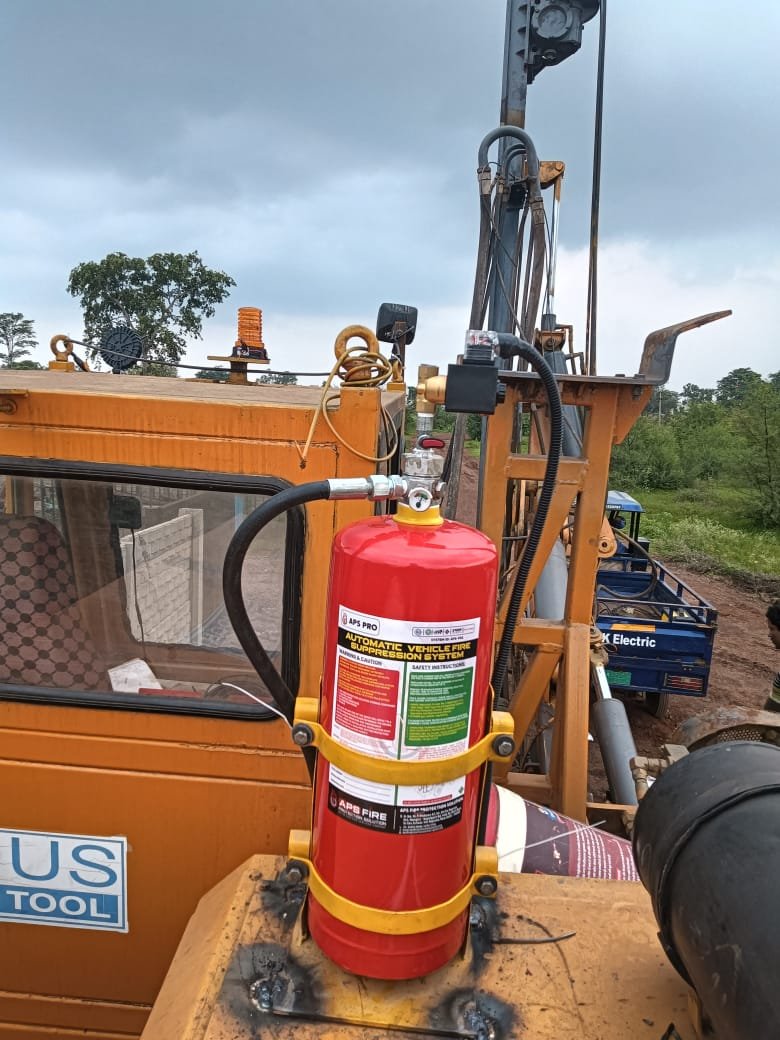
Automatic Vehicle Fire Suppression System For vehicle applications — and particularly for HEMM (Heavy Earth Moving Machinery) in Indian mines under DGMS Circular No. 6 of 2020 — the Automatic Fire Detection and Suppression System (AFDSS) works through a chain of events that is designed to complete from fire detection to full agent discharge in under 30 seconds.
Linear heat detection cable or thermal detection tube is routed through the fire hazard zones of the vehicle — engine bay, hydraulic bay, turbocharger vicinity, exhaust routing, and fuel system areas. When temperature at any point on the detection circuit reaches the rated activation temperature (typically 138°C for pre-alarm and 180°C for automatic suppression in HEMM applications), the control panel receives the signal, activates the cabin alarm (minimum 90–100 dB, audible above diesel engine noise), and after a brief confirmation delay, sends the actuation signal to the suppression cylinders.
Nitrogen pressure from the pilot cylinder forces dry chemical powder (or twin-agent foam+DCP in larger HEMM installations) through the pipe network to the nozzles positioned inside the fire hazard zones. Full agent discharge completes in 7–10 seconds. Simultaneously, the control panel sends an engine cutoff signal — removing the ignition source and reducing fuel flow — and activates any external warning lights or alarms.
The powder discharge attacks the fire on multiple levels: the chemical chain interruption of the DCP agent stops the flame chemistry, the physical powder particles mechanically disrupt the flame structure, and the nitrogen propellant displaces oxygen locally at the discharge nozzles. For Class A, B, and C fires — which cover virtually all vehicle engine fires — DCP is effective and fast. For re-ignition prevention on large fuel spills (characteristic of major HEMM hydraulic failures), the foam component in twin-agent systems provides the lasting surface blanket that DCP alone cannot.
Wet Chemical Kitchen Suppression Systems — How Saponification Works
The wet chemical kitchen suppression system deserves a specific working-principle explanation because the chemistry is genuinely different from every other suppression type, and misunderstanding it leads to dangerous incorrect choices (like installing a standard sprinkler over a commercial kitchen and expecting it to work on a Class F cooking oil fire).
When cooking oil — refined vegetable oil, ghee, vanaspati, or animal fats — reaches temperatures above 340°C without being cooled or removed from heat, it auto-ignites. The resulting fire is self-sustaining and extremely hot. At these temperatures, a water discharge does not cool the oil — it instantly flash-vaporises, converting one litre of water into 1,700 litres of steam in milliseconds, explosively projecting burning oil droplets across the kitchen environment. This is why water-based systems are dangerous on Class F fires, not merely ineffective.
The wet chemical agent — typically potassium citrate, potassium acetate, or potassium carbonate solution — works through a two-part mechanism. First, the water carrier of the solution provides some immediate cooling as it contacts the oil surface. But the critical mechanism is the chemical reaction between the alkaline potassium salt and the hot fatty acids in the oil — saponification. This reaction produces a thick, soap-like substance at the oil surface that forms a coherent, tenacious layer. This layer physically seals the oil from atmospheric oxygen (extinguishing the fire) and — critically — continues to cool the oil surface as long as it remains intact, preventing re-ignition even as the oil temperature remains elevated. The saponified layer is stable at cooking oil temperatures and will not break down under the radiant heat of the surrounding kitchen environment.
Simultaneously, the system activates a gas isolation valve — closing the LPG or piped gas supply to all connected cooking appliances — removing the fuel source from the risk area entirely.
Tube-Based Automatic Suppression Systems — Power-Free Fire Protection
Tube-based systems deserve specific attention because they represent the fastest-growing category of automatic suppression in India's commercial and industrial market, yet remain poorly understood by many building owners and facility managers.
A tube-based system uses a flexible polymer tube filled with suppression agent or connected to a separate agent cylinder — routed directly through or adjacent to the fire hazard zone inside an enclosure. The tube itself is both the detection element and, in direct-acting systems, the delivery mechanism.
The tube is maintained at a defined internal pressure. The polymer formulation is selected to rupture at a specific temperature — typically 110°C for standard direct-acting systems, up to 180°C for high-temperature variants. When flame or extreme heat contacts the tube, it softens and ruptures at the hottest point. The pressure inside the tube drops at the rupture point, and the suppression agent is expelled directly from the rupture into the protected enclosure — precisely at the fire location. There is no signal, no FACP, no wiring, no solenoid. The physics of pressure differential does everything.
This makes tube-based systems uniquely reliable in applications where conventional electrical systems cannot be guaranteed: CNC machine enclosures where metal-cutting fluid vapours contaminate electrical contacts, electrical panels where internal wiring faults are the fire cause and the detection wiring may fail simultaneously, vehicle engine bays where vibration degrades electrical connections over time, and remote or unmanned installations where battery backup cannot be guaranteed.
In India, tube-based systems are specified for electrical distribution boards in factories, server rack-level protection in smaller IT installations and branch offices, vehicle engine bays, CNC machine cabinets, and generator control panels. APS Fire Protection Solutions supplies and installs tube-based systems using PESO-approved cylinders with clean agent (Novec 1230 or FM-200) or CO2 as the suppression media, with tube lengths and cylinder sizing matched to the specific enclosure volume and fire hazard.
Why Automatic Fire Suppression Systems Fail — The Real List
This section does not exist anywhere in the top search results for this topic. We are including it because it represents genuine engineering expertise that anyone operating these systems in India needs to know.
Reason 1: Inadequate detection for the fire type
A fixed-temperature heat detector set at 68°C in a server room with a smouldering cable fault will not alarm until the temperature at the detector rises to 68°C — which may be after the smouldering fault has been developing for 20–30 minutes and has generated enough heat to damage adjacent cable runs. An aspirating smoke detector in the same room would have alarmed within the first two minutes of combustion. The suppression system was technically correct — the detection system was wrong for the fire risk.
Reason 2: Insufficient agent for the fire load
In budget Indian installations, cylinder sizing is sometimes based on the smallest compliant capacity for a room of a given size, without accounting for the actual fire load (quantity and type of combustibles in the room). A Clean Agent Fire Suppression System designed for a notional "empty server room" that is actually housing a dense rack configuration with high cable density and multiple UPS units may not have sufficient agent volume to reach suppression concentration against the heat release rate of the actual fire. NFPA 2001 and IS 16018:2012 both require agent quantity calculation to account for the specific hazard — a calculation that requires knowledge of the actual room contents, not just its dimensions.
Reason 3: Room integrity failure
For total flooding systems (clean agent, CO2, inert gas), the protected enclosure must retain agent at design concentration for the full holdtime. A server room with unsealed cable tray penetrations through the false ceiling, with no interlock on the HVAC supply dampers, with an underseal gap under the access door — will lose agent concentration so rapidly that suppression may not be achieved even if the discharge itself was perfect. Pre-commissioning room integrity testing (Door Fan Test) to IS 16018 requirements is not optional — it is the only way to verify that the room can actually hold the agent. In APS Fire Protection Solutions installations, room integrity testing is standard procedure for every clean agent installation.
Reason 4: Maintenance neglect
A suppression system in good cosmetic condition — red cylinders with green gauges, clean nozzles, no visible damage — may have a detection circuit with a broken LHD cable segment that creates a false "system normal" condition on the control panel. It may have a DCP cylinder that has partially caked due to moisture ingress because the fill valve seal was last replaced four years ago. It may have a pipe joint that has backed off 1.5 turns from vibration and will fail to deliver adequate pressure to the zone nozzles. None of these faults are visible without opening the system and testing each component. Regular maintenance — specific, documented, to IS 2189 schedules for detection systems and NFPA 25 for water-based systems — is the only way to know the system will actually perform.
Reason 5: Wrong system for the application
A sprinkler system installed over a data centre because the building specification required "fire suppression" will destroy the data centre on its first activation — the water discharge is the disaster, not a fire it might suppress. A DCP system in a pharmaceutical clean room will contaminate the production environment with powder residue, triggering a full decontamination shutdown more expensive than the fire it suppressed. A CO2 system in a normally occupied electrical room will create a life-safety hazard the moment it activates. These are not edge cases — they are documented incident patterns in India that result from suppression systems being specified without genuine analysis of the fire risk and the consequences of suppression agent contact with the protected environment.
Indian Compliance Framework — What You Must Know
Automatic fire suppression systems in India are governed by a layered framework of national standards, state regulations, and building-specific requirements. Understanding which layer applies to your installation is the starting point for any compliance decision.
The National Building Code of India 2016 (NBC 2016), Part 4 — Fire and Life Safety — is the foundational document. It classifies buildings by occupancy group (Group A residential through Group I hazardous) and specifies the fire protection measures required for each. Automatic fire suppression (sprinklers or equivalent) is required in high-rise residential buildings above 24 metres, hotels, hospitals, multiplexes, and most large commercial buildings. The NBC is published by the Bureau of Indian Standards (BIS) and is technically a recommendatory document at the national level, but the Ministry of Home Affairs has directed all states to incorporate it into local building bye-laws — making it effectively mandatory in most major Indian cities.
IS 15105:2002 covers the design and installation of fixed automatic sprinkler systems. IS 2189:2008 covers fire detection and alarm systems. IS 16018:2012 covers clean agent fire extinguishing systems. IS 15683 and IS 16018 together cover the product certification requirements for suppression system components. PESO approval is specifically required for pressurised cylinders. These Indian standards are the compliance basis that fire departments use for NOC issuance — a certificate without which buildings cannot legally be occupied in most Indian cities.
NFPA standards — particularly NFPA 13 (sprinklers), NFPA 2001 (clean agents), NFPA 17 (dry chemical), NFPA 17A (wet chemical), and NFPA 72 (fire alarm) — are widely referenced in India, particularly in data centres, industrial facilities, and projects with international clients who specify NFPA compliance. NFPA standards and IS standards are broadly aligned in their technical requirements, though there are specific differences in design parameters and documentation requirements that qualified Indian fire safety engineers navigate routinely.
For mining applications, DGMS Technical Circular No. 6 of 2020 mandates AFDSS for all HEMM vehicles in Indian coal and metalliferous mines. For buses and passenger vehicles, AIS-135 (with its 2022, 2023, and 2025 amendments) governs engine compartment and occupant compartment fire detection and suppression requirements. These specific frameworks are the compliance basis that mine managers and fleet operators must meet.
How Much Does an Automatic Fire Suppression System Cost in India?
Pricing in Indian rupees — something no competing page on this topic provides — is one of the most practical pieces of information any property owner, facility manager, or safety officer needs when evaluating suppression systems. The following are indicative 2025–2026 market ranges for the main system types. All costs are approximate and vary significantly based on building size, protection zone complexity, city, and contractor scope.
Automatic sprinkler system (commercial, wet pipe): Rs. 60–120 per square foot installed, including fire pump set. A 10,000 sq ft office floor in Mumbai or Bengaluru would typically cost Rs. 6–12 lakh for a complete sprinkler system. Annual AMC: Rs. 20,000–60,000 depending on system size.
Clean agent FM-200 system (server room up to 30 m²): Rs. 2.5 lakh to Rs. 8 lakh installed, including FACP, detectors, cylinder, and room integrity sealing. Annual AMC: Rs. 20,000–60,000.
Clean agent Novec 1230 system (equivalent scope): Rs. 3.5 lakh to Rs. 12 lakh installed, reflecting the premium agent cost. Annual AMC: Rs. 25,000–80,000.
Wet chemical kitchen suppression system: Rs. 80,000 to Rs. 2,50,000 installed for a commercial kitchen, depending on the number of cooking appliances and hood dimensions. Annual AMC: Rs. 8,000–20,000.
Vehicle AFDSS for HEMM (DCP, mining standard): Rs. 55,000 to Rs. 1,00,000 per vehicle installed, depending on vehicle size and zone count. For a large 120-tonne dumper with twin-agent system: Rs. 3.5–8 lakh installed. Annual AMC: 10–15% of installation cost per year.
Tube-based system for electrical panel: Rs. 15,000 to Rs. 60,000 per panel depending on enclosure volume and agent type. No AMC required for direct-acting systems beyond annual pressure checks.
These costs should be evaluated against what an uncontrolled fire in the protected environment would cost — in equipment replacement, business downtime, insurance consequences, regulatory investigation, and in the worst case, human harm. The ROI calculation on a correctly specified fire suppression system is almost always strongly positive when the full consequence of the protected risk is honestly assessed.
Choosing the Right Automatic Fire Suppression System — The APS Framework
The single most common mistake in Indian fire suppression procurement is selecting a system based on the lowest per-unit price rather than on the correct match between system type, fire risk, and application. The second most common mistake is selecting a system based on what a previous installation used, without considering whether that installation's risk profile matches the current requirement.
APS Fire Protection Solutions begins every client engagement with a fire risk assessment that answers five questions before any product recommendation is made:
First — what fire classes are present in this environment? The presence of Class B (flammable liquids), Class C (gas), Class E (electrical), or Class F (cooking oil) risks changes the agent selection fundamentally. An environment with only Class A fire risk (paper, wood, fabric) can be effectively protected by any water-based system. An environment with Class E risk needs a non-conductive, non-damaging agent. An environment with Class F risk specifically requires wet chemical. Getting this right is the foundation of everything that follows.
Second — what is the consequence of agent contact with the protected environment? Sprinkler water is inexpensive and safe but will destroy electronics and archive documents. DCP powder is fast and effective but will contaminate pharmaceutical clean rooms and food production areas. CO2 is lethal at suppression concentrations. Clean agent gas is safe and residue-free but expensive. The right agent is the one whose suppression effect is effective and whose non-fire consequences are acceptable.
Third — is this environment occupied or unoccupied during operation? Occupied environments require agents that are safe for human exposure at design concentration. Unoccupied environments allow the use of CO2 and other agents that would be hazardous to people.
Fourth — what are the detection requirements? The fire type determines the most effective detection technology. The environment determines which detection technologies are physically and electrically compatible. The required response time determines whether enhanced detection (aspirating, multi-sensor) is necessary.
Fifth — what compliance framework applies? The building type, use, and location determine which IS codes, NBC requirements, NFPA standards, and regulatory certifications the system must meet. Getting this right from design stage avoids costly re-specification during the NOC process.
About APS Fire Protection Solutions
APS Fire Protection Solutions is headquartered in New Delhi and provides automatic fire suppression system design, supply, installation, and Annual Maintenance Contracts across India. Our product range covers every suppression system type covered in this guide: automatic vehicle AFDSS for mining and heavy vehicles, clean agent FM-200 and Novec 1230 systems for server rooms and data centres, wet chemical kitchen suppression for hotels and restaurants, tube-based systems for Electrical Panel and CNC machines, and CO2 flooding for industrial applications.
Every APS installation is designed to the applicable IS code, NBC 2016, and where required NFPA and DGMS standards. We supply PESO-approved cylinders, use IS-certified components, and provide full NOC documentation packages for fire department submission. Our AMC contracts cover all scheduled maintenance requirements under IS 2189, NFPA 25, and NFPA 2001 as applicable.
If you are evaluating an automatic fire suppression system for any environment in India — contact APS Fire Protection Solutions for a no-obligation consultation and site assessment.