
What Is a Vehicle Fire Suppression System? The Definitive Guide for Indian Fleet Operators, Mine Managers, and Safety Officers
The Fire That Changes How You Think About Vehicle Safety
It is 2:40 in the afternoon at a coal mine in Singrauli. A 120-tonne dumper is hauling overburden from the pit bench to the dump. The operator notices nothing unusual. The cab temperature gauge is normal. There is no warning light. There is no alarm.
Thirty metres below and behind him, a hydraulic return line — weakened over months of thermal cycling — has developed a pinhole rupture. At 250 bar of pressure, hydraulic oil is atomising into a fine mist and spraying directly onto the turbocharger housing, which is running at surface temperatures above 650°C. The mist ignites instantly. The flame spreads across the hydraulic bay in under eight seconds.
By the time the operator smells smoke and looks in his mirror, the engine compartment is fully involved. He has maybe 90 seconds to descend a 3-metre ladder — past the burning engine bay — and reach clear ground.
This is not a hypothetical. Variations of this sequence have killed and severely burned operators in Indian mines, on Indian highways, and on Indian construction sites for decades. And for decades, the standard response has been to mount a 9-kilogram dry powder extinguisher to the cab frame — a device that requires a person to be standing next to the fire, with hands free, in a calm enough state to pull a pin, aim accurately, and discharge for a sustained period against a fire that is already beyond portable extinguisher range.
A Vehicle Fire Suppression System exists to break that sequence entirely. It detects the fire in the first five seconds, before the operator knows it is there. It discharges agent directly at the fire source without any human action. And it does this whether the operator is in the cab, out of the cab, whether it is day or night, and whether the vehicle is moving at 40 km/h or sitting at idle.
That is the fundamental difference. Not technology for technology's sake. A specific engineering answer to a specific, deadly problem.
So What Exactly Is a Vehicle Fire Suppression System?
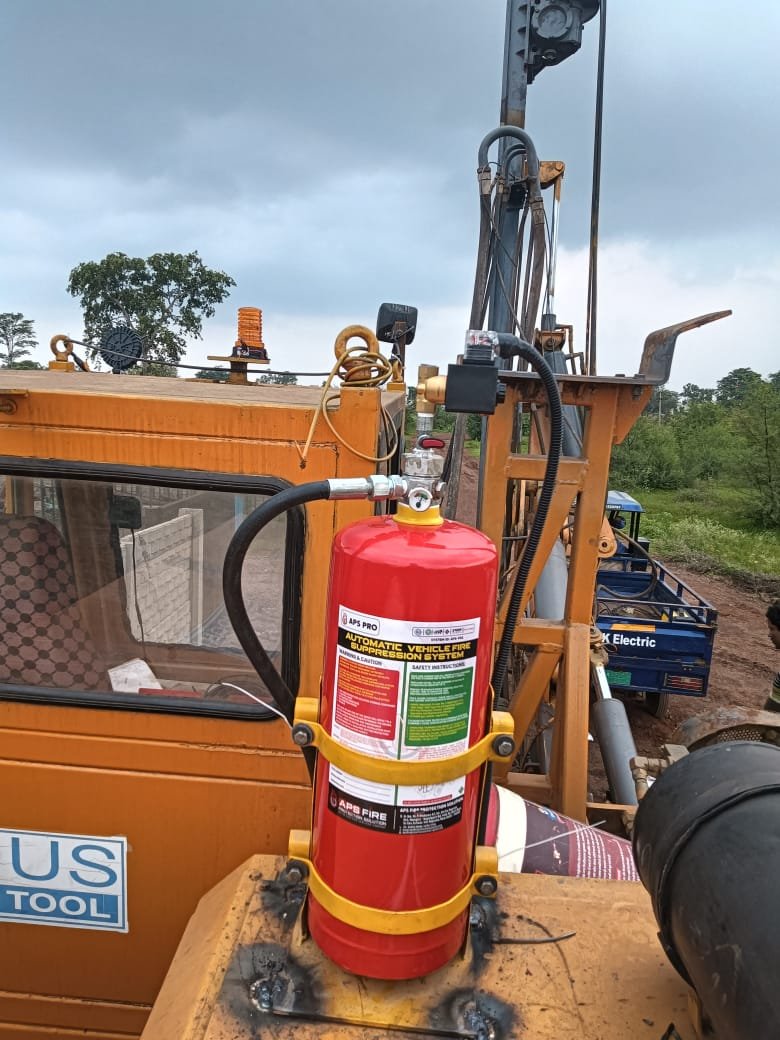
A vehicle fire suppression system — also called a Vehicle Fire Detection and Suppression System (VFDSS) or, in the mining context, an Automatic Fire Detection and Suppression System (AFDSS) — is a fixed, engineered installation permanently mounted on a vehicle that automatically detects fire in designated protection zones and releases a suppression agent through a purpose-designed nozzle network to extinguish or control that fire.
The critical word is automatic. The system does not wait for a human decision. It does not require the operator to be present, conscious, or untangled from an emergency. The detection, the alarm, and the discharge happen through a self-contained mechanism that responds to the physics of fire — heat, flame, or pressure change — faster than any human reflex can.
This distinguishes a vehicle fire suppression system from every other item in a vehicle's fire safety toolkit. Fire extinguishers, sand buckets, foam canisters — all of these are tools for a person to use on a fire they can see and reach. A suppression system is the protection that works when that person cannot act, or when the fire is in a location they cannot safely access.
In technical terms, a vehicle fire suppression system is built around three integrated functions: detection of a fire event, initiation of an alarm sequence, and controlled release of a suppression agent through a fixed delivery network positioned at the fire hazard zones. Every component — sensor, control unit, cylinder, pipe, nozzle — is selected and positioned based on a risk assessment of the specific vehicle, its fuel and fluid loads, its operating conditions, and the fire classes most likely to occur.
Why Vehicle Fires Are Different — And More Dangerous Than Most People Realise
A building fire gives you time. Smoke detectors trip. Sprinklers activate overhead. Fire doors slow the spread. Corridors lead to stairwells. The architecture itself is designed, at least in part, with the assumption that fire will happen and people will need to escape.
A vehicle fire on a heavy machine gives you almost none of that. Here is what actually happens, and why the engineering response has to be fundamentally different.
The ignition triangle on heavy vehicles is always loaded
A large mining dumper, an excavator, or a loaded construction crane carries hundreds of litres of diesel fuel in an exposed saddle tank, 200–400 litres of hydraulic oil running at high pressure through hoses that pass within centimetres of exhaust manifolds and turbochargers, engine oil, coolant, battery acid, and in some cases DEF (diesel exhaust fluid) — all in a chassis that vibrates continuously, operates in extreme ambient temperatures, and runs through dust, rock particle abrasion, and chemical exposure on every shift.
In fire science terms, the fuel load on a heavy vehicle is constant, enormous, and spread across the entire chassis. The ignition sources — turbocharger surfaces, exhaust components, electrical arcing, hydraulic system friction — run at temperatures that would ignite atomised oil virtually on contact. And the oxygen supply is guaranteed. All three sides of the fire triangle are present, at elevated levels, every minute the machine is running.
The fire development timeline is brutal
Research on heavy vehicle fires — both in mining and highway transport contexts — consistently shows that engine compartment fires reach full involvement in 90 seconds to three minutes from initial ignition. This is not the slow, smokily developing fire of a smouldering office waste bin. Hydraulic fluid igniting under pressure, or a diesel fuel leak contacting a hot exhaust surface, produces a fast, high-temperature fire that spreads along fuel paths and heat sources simultaneously.
Ninety seconds is approximately how long it takes an operator to become aware of the fire, process the threat, physically leave the cab, descend the access ladder (which on a 120-tonne dumper is mounted on the same side as the engine bay), and reach clear ground. It is not how long it takes to go back and retrieve a fire extinguisher, locate the fire, and attempt suppression.
The access problem is almost always fatal to manual response
The most fire-prone zones on a heavy vehicle — engine bay, hydraulic bay, exhaust area, turbocharger housing — are also the most inaccessible zones for a person attempting to use a portable extinguisher. On large HEMM vehicles, these areas are enclosed within the chassis structure, reachable only through access panels that may themselves be in or near the fire zone. Even on buses and trucks, the engine bay access requires the vehicle to be stopped, the driver to leave the cab, and suppression to begin from outside the vehicle — all while the fire is developing.
An automatic suppression system has nozzles positioned inside these zones before the vehicle enters service. The agent goes to the fire, through the structure, from inside. This is the engineering advantage that no portable device can replicate.
The real cost of an unprotected vehicle fire in India
Beyond the human cost — which is the only cost that matters absolutely — a single HEMM fire in an Indian mine carries a cascading economic impact that fleet managers and mine operators rarely calculate fully before the first incident. The vehicle replacement cost for a 120-tonne dumper runs between Rs. 4–7 crore. Lost production during the investigation and clearance period — typically 2–4 weeks for a serious fire — adds to that. Insurance excess, regulatory investigation by DGMS inspectors, potential stop-work orders across the fleet while compliance is established, and the reputational cost with contract holders and regulators all accumulate on top of the physical damage.
The total cost of a single serious HEMM fire event, including all downstream consequences, routinely runs to Rs. 8–15 crore when aggregated properly. The cost of installing and maintaining a vehicle fire suppression system on that same dumper over its operational life is a fraction of that figure.
How a Vehicle Fire Suppression System Works — Component by Component
Understanding how the system works at a technical level is essential before making a purchasing, installation, or compliance decision. Every component in the system has a specific function, and the failure of any one component undermines the whole.
The Detection System — The System's Eyes
Detection is the first and most critical stage. The suppression system can only respond to what it detects, and it can only detect what its sensors can measure. In vehicle applications, two detection technologies dominate the Indian market and are both recognised under DGMS Circular No. 6 of 2020 and AIS-135 standards.
Linear Heat Detection (LHD) Cable is a fixed-temperature digital sensor routed as a continuous cable through the protected zones — around the engine bay, along hydraulic hose runs, through the exhaust vicinity, and through any other designated fire risk areas. The cable consists of two conductors separated by a heat-sensitive polymer insulation. When ambient temperature at any point along the cable reaches the rated activation temperature — 138°C for pre-alarm in bus applications and 180°C for automatic suppression activation in HEMM applications — the insulation softens and allows the conductors to contact each other, completing a circuit that triggers the control unit. LHD cable is robust, vibration-resistant, highly reliable in dusty and high-temperature environments, and can be routed to cover every inch of the fire risk zone. It is the most widely used detection method in Indian HEMM AFDSS installations.
Pressurised Polymer Detection Tubing (commonly referred to as Firetrace, Amerex detection tube, or simply "fire tube") is a hollow, flexible polymer tube filled with pressurised gas (typically nitrogen at 10–15 bar) that is routed directly through or immediately adjacent to the fire hazard areas. When flame or extreme heat contacts the tube at any point — with activation temperatures typically between 110°C and 150°C for standard tubing — the tube wall ruptures at the hottest point. The resulting pressure drop triggers the suppression agent release. In direct-acting systems, the tube itself becomes the delivery nozzle, with agent escaping through the rupture. In indirect systems, the pressure drop signals a separate agent cylinder to discharge through a conventional nozzle network.
The detection tubing approach carries one critical advantage: in its basic direct-acting form, it requires no electrical power, no control panel, and no wiring. The physics of pressure drop does the work. This makes it exceptionally reliable in harsh electrical environments — a significant advantage on mining HEMM vehicles where vibration-induced wiring faults are a genuine concern. The trade-off is a faster "use-by" condition: the tube must be replaced after any discharge, and pressure integrity must be verified at every maintenance interval.
Multi-sensor Detectors — combining smoke detection, heat sensing, and sometimes infrared flame detection in a single unit — are increasingly specified in bus and passenger vehicle applications under the updated AIS-135 standard. Amendment No. 2 of September 2023 and the further Amendment No. 3 of May 2025 both push toward multi-sensor detection for the occupant compartment of buses, reflecting the findings of DRDO's Centre for Fire, Explosive, and Environment Safety (CFEES) research that single-point heat detection in passenger compartments gives insufficient dwell time for evacuation in modern high-speed bus fires.
The Control Unit — The System's Brain
The fire alarm control panel, or control unit, sits at the heart of the system. It continuously monitors all detection circuits, processes incoming signals, manages the alarm sequence, and controls the agent release. On a modern HEMM AFDSS installation, the control unit also interfaces with the vehicle's CAN bus or ignition system to trigger automatic engine shutdown on fire confirmation — removing the fuel source and cutting the ignition from the equation simultaneously.
A properly specified control unit for Indian mining applications needs to meet several non-negotiable requirements. It must be rated for continuous operation in ambient temperatures up to 70°C, because mine environments — particularly in Central and Eastern India in summer — regularly exceed 50°C at vehicle chassis level. It must be vibration-resistant to IEC 60068-2-6 standards because mining HEMM vibration profiles are severe. It must have a battery backup to maintain alarm and partial suppression functionality in the event of a main electrical failure. And it must log events — system status, alarm triggers, discharge events, fault conditions — for the maintenance and compliance documentation that DGMS inspectors will request.
Manual override capability is a mandatory requirement under both DGMS guidelines and AIS-135. The operator must always be able to activate the system manually from the cab, and in certain configurations, must also be able to abort an inadvertent activation. These manual controls must be clearly marked, easily reachable from the operator position, and tested at every maintenance interval.
The Agent Storage System — The System's Muscle
The suppression agent is stored in pressurised cylinders, typically nitrogen-pressurised steel or stainless steel vessels rated to PESO (Petroleum and Explosives Safety Organisation) specifications in India. The cylinder configuration depends on the suppression agent and the system design — single cylinder, multiple cylinders, or a pilot-main cylinder configuration for larger HEMM installations.
In a typical HEMM AFDSS using DCP (Dry Chemical Powder) as the primary agent, the configuration uses a small nitrogen pilot cylinder to provide the actuation pressure. When the solenoid valve on the pilot cylinder receives the signal from the control unit, it opens and releases nitrogen into the main DCP cylinders, which then forces the powder through the pipe network to the discharge nozzles. This pilot-main configuration allows a compact, low-power solenoid to reliably control a much larger agent payload than a direct solenoid on the main cylinder would permit.
For twin-agent systems — which combine a fast-knockdown DCP discharge with a securing foam application — the cylinder arrangement is more complex, with the two agents stored separately and discharged in a timed sequence: DCP first to knock down the active flame, followed immediately by AFFF or aqueous foam to cool and seal the fuel surface and prevent re-ignition.
The Delivery Network — Getting the Agent to the Fire
The pipes, fittings, and nozzles that carry the suppression agent from the storage cylinders to the fire hazard zones are, in the field, where many vehicle suppression systems fail when they are needed. Not because the agent is wrong, not because the detection failed — but because the delivery network was installed incorrectly, maintained inadequately, or specified without proper attention to the physical layout of the specific vehicle.
Vehicle suppression pipe networks are not simply domestic sprinkler pipes bolted to a chassis. They run through areas of extreme heat cycling, heavy vibration, chemical contamination, and physical impact. Every pipe joint is a potential vibration failure point. Every nozzle position is a hydraulic calculation — the right flow rate, the right spray angle, the correct coverage area for the specific fire zone — and any deviation from the design produces proportional reduction in suppression performance.
At APS Fire Protection Solutions, every vehicle suppression installation begins with a vehicle-specific risk assessment that maps the actual fire hazard zones for that make, model, and configuration of vehicle. Nozzle positions are designed to provide minimum coverage overlap across every point in the protected zones. Pipe runs are routed away from the highest mechanical stress points, protected with heat-resistant sleeving where they pass through hot zones, and secured with vibration-resistant clamps at intervals that account for the vehicle's typical vibration spectrum.
This is not an over-specification. It is the difference between a system that performs at the moment of fire and a system that fails because a pipe joint loosened over 2,000 hours of operation.
Alarm and Signalling — The System's Voice
When the detection system triggers, the control unit simultaneously initiates the alarm sequence: an audible alarm at the operator cab (minimum 90dB above ambient cabin noise as specified under AIS-135 for bus applications, and sufficient to be heard clearly in open cab HEMM environments), a visual strobe or indicator light visible to the operator, and — in fully networked installations — a signal to a remote monitoring station or fleet management system.
The alarm does two things. It gives the operator the information they need to begin evacuation immediately, before the suppression discharge. And it creates the documented event record that is essential for post-incident investigation, insurance claims, and DGMS compliance reporting.
The sequence matters. Alarm first, always. Suppression systems that discharge without any prior alarm give operators no warning, no time to respond, and create serious safety risks from the suppression agent discharge itself in enclosed cab environments.
Suppression Agents for Vehicle Systems — Choosing the Right One
No single suppression agent is the right answer for every vehicle or every fire zone. The agent selection decision is one of the most important in any vehicle suppression system design, and it requires honest evaluation of the fire risk profile, the operating environment, the post-discharge consequences, and the maintenance commitments the operator can realistically sustain.
Dry Chemical Powder (DCP) — The Workhorse of Indian HEMM Protection
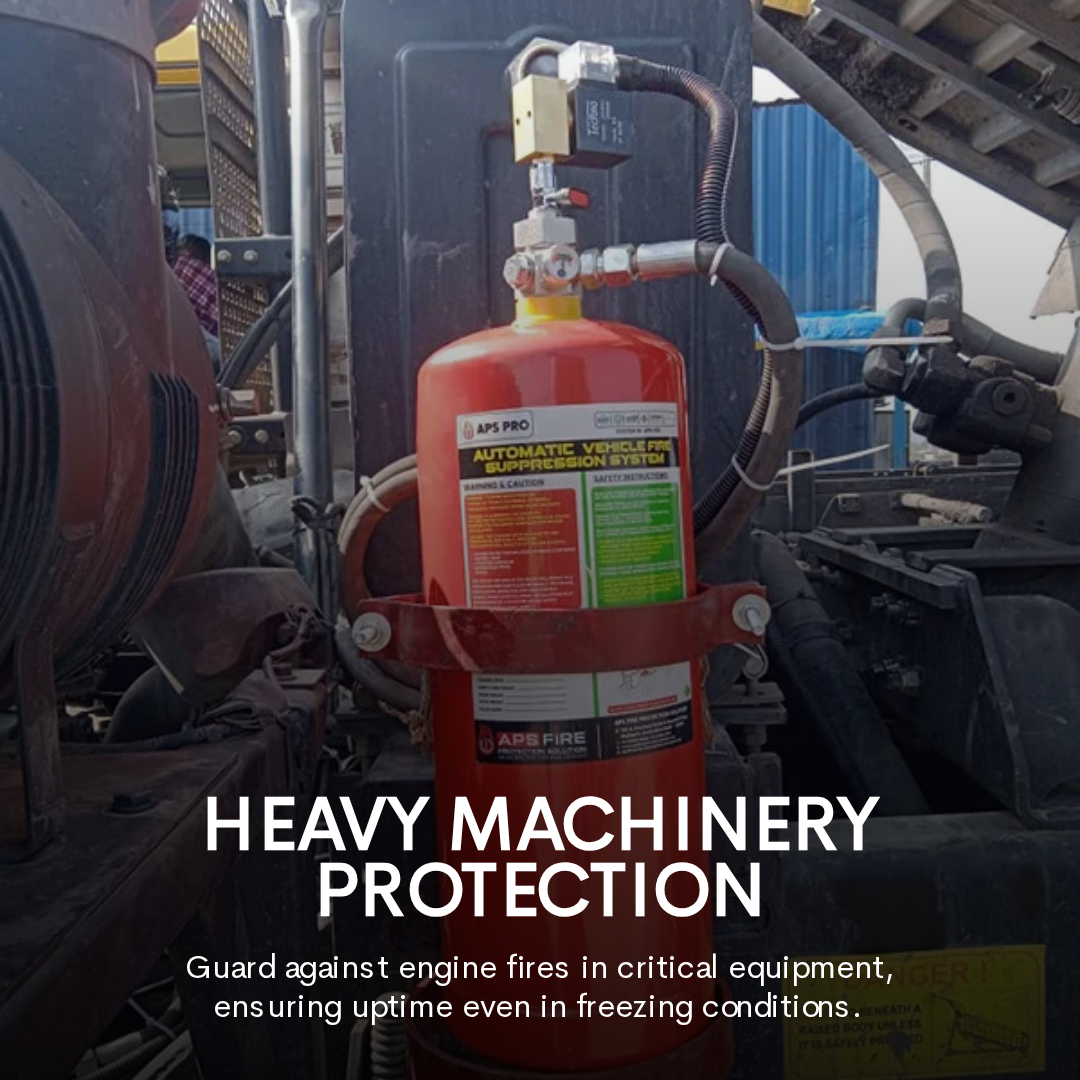
Dry Chemical Powder — specifically monoammonium phosphate (MAP) ABC powder or potassium bicarbonate (BC powder) — is the most widely used suppression agent in Indian vehicle fire suppression systems, particularly for HEMM mining and construction equipment applications. Checkout HEMM Automatic Fire Suppression System
The reason is straightforward: DCP is the most broadly effective agent across the fire classes most common on heavy vehicles. Diesel fuel fires (Class B), hydraulic oil fires (Class B), electrical fires from wiring faults (Class E), and secondary solid material ignition (Class A) are all within DCP's effective suppression range. The powder interrupts the combustion chain reaction chemically while simultaneously displacing oxygen in the fire zone and — at sufficient discharge rates — physically knocking down flame. The combined effect is fast, violent suppression that is proportionate to the fast, violent nature of vehicle engine fires.
DCP is stored at relatively low cost, remains effective across the extreme temperature range of Indian mining environments (from -5°C in winter northern India mine operations to 55°C ambient in summer central India), and can be refilled on-site with equipment that any competent service contractor can operate.
The acknowledged limitation of DCP is post-discharge residue. MAP powder is mildly corrosive and will coat every surface in the protected zone. On electronic components, the powder must be cleaned off promptly — within hours rather than days — to prevent corrosion of contacts and connectors. In a vehicle engine bay, this means the area must be thoroughly cleaned and inspected before the vehicle is returned to service, and any electrical components that were directly exposed should be checked for functionality. This is not a reason to avoid DCP — it is a maintenance reality that competent service contracts must include in their post-discharge response protocol.
Twin-Agent Systems (DCP + Foam) — Best Practice for Fuel-Heavy Environments
A twin-agent system combines the fast flame knockdown of dry chemical powder with the cooling and re-ignition prevention properties of an aqueous foam or light water agent. The sequence is critical to how these systems work. The DCP discharges first, typically within 15–20 seconds of system activation, and knocks down the active flame rapidly. The foam discharges immediately afterwards — within the same activation event — and flows across the fuel surface to cool it below re-ignition temperature and seal it from atmospheric oxygen.
This sequential discharge solves the primary weakness of DCP-only systems in fuel-heavy environments: re-ignition. A ruptured hydraulic hose or cracked fuel line that is on fire when the DCP discharges does not stop leaking after the DCP knocks down the flame. The fuel continues to flow, still hot from the fire event, and can re-ignite on residual heat sources. The foam layer from the twin-agent system addresses this directly, providing a physical and thermal barrier between the fuel and any remaining ignition potential.
DGMS guidelines recognise twin-agent systems as best practice for protecting the engine and hydraulic bays of large HEMM equipment, and international standards including NFPA 17 acknowledge the twin-agent approach for high fuel-load vehicle applications. APS Fire Protection Solutions specifies twin-agent systems for all dumper, excavator, and dozer installations where the hydraulic fluid volume exceeds 150 litres, as a matter of engineering practice rather than minimum compliance.
Clean Agent Systems (FM-200 / Novec 1230) — When Zero Residue Is Non-Negotiable
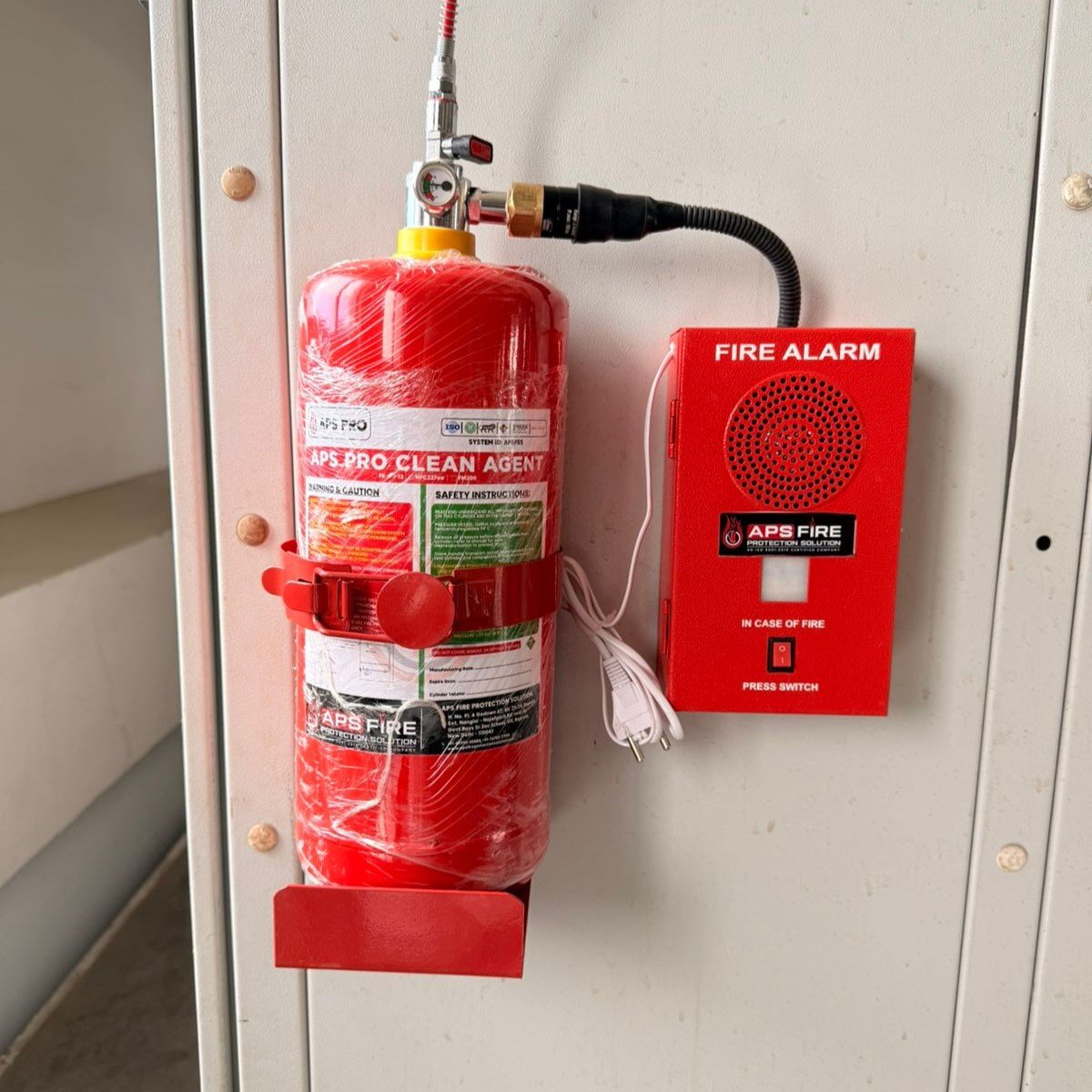
Clean Agent Fire Suppression System — specifically FM-200 Fire Suppression System (HFC-227ea) or Novec 1230 (FK-5-1-12) — is the right choice for vehicle applications where post-discharge residue is unacceptable and the protected environment can be treated as an enclosed volume for agent flooding purposes.
In vehicle contexts, this most commonly means the operator cab, the engine electronic control unit (ECU) housing, or precision electronic components on high-value vehicles where DCP contamination would cause damage exceeding the benefit of suppression. Airport ground support vehicles — baggage tractors, belt loaders, pushback tugs — operating in close proximity to aircraft often specify clean agent systems precisely because DCP powder contaminating aircraft components or cargo areas is an operational disaster even if it successfully suppresses a vehicle fire. Defence vehicles, armoured personnel carriers, and certain high-specification civilian vehicles use clean agents for the same reason.
The operational constraint is that clean agents work best in enclosed or semi-enclosed volumes where they can reach suppression concentration. An open engine bay on a highway truck, with airflow from vehicle motion continuously purging the protected zone, is a poor environment for clean agent total-flooding. For that application, DCP or twin-agent remains more appropriate. The nozzle network design, the vehicle speed at activation, and the degree of enclosure of the protected zone all factor into whether clean agent is technically viable for a specific vehicle application.
CO2 Systems — Specific to Unmanned or Fully Enclosed Applications
CO2 at suppression concentrations is lethal. In vehicle applications, CO2 suppression systems are therefore restricted to normally unmanned engine compartments where there is no possibility of operator or bystander exposure. On self-propelled agricultural equipment, generator sets on temporary construction power systems, and certain industrial engines in fixed-plant vehicle configurations, CO2 systems can be appropriately specified. They are categorically not appropriate for cabs, passenger compartments, or any zone where a person might be present during suppression discharge. Knnow more about CO2 Flooding Fire Suppression System
Where Indian Law Stands — DGMS, AIS-135, and Your Compliance Obligations
The regulatory landscape for Vehicle Fire Suppression System in India has changed significantly in the last five years, and it continues to evolve. Understanding exactly where you stand — and where the obligations sit — is not optional if you operate HEMM, buses, or passenger-carrying vehicles in India.
DGMS Technical Circular No. 6 of 2020 — The HEMM Mandate
Issued by the Director General of Mines Safety from Dhanbad on 27 February 2020, DGMS Technical Circular No. 6 of 2020 is the foundational document for HEMM fire safety in Indian coal and metalliferous mines. It was the product of a one-day technical workshop held at DGMS Headquarters on 7 January 2020 — the 119th Foundation Day — attended by over 260 senior representatives from coal mines, metalliferous mines, OEMs, and educational institutions.
The Circular mandates minimum design requirements for safety features — including Automatic Fire Detection and Suppression Systems — to be incorporated into Heavy Earth Moving Machinery and heavy and light vehicles operating in opencast mines. The mandate covers dumpers, dozers, drill machines, shovels, and excavators. It applies to both departmental vehicles (owned by the mining company) and contractual vehicles (owned by contractors operating within the mine).
The Circular is addressed to Owners, Agents, and Managers of coal and metalliferous mines, and to OEMs (Original Equipment Manufacturers). It is explicitly framed as a minimum requirement — the circular itself states that the enclosed guidelines represent "only the minimum recommended levels and may be altered from time to time." Compliance is enforced through DGMS inspections, and non-compliant HEMM vehicles are subject to prohibition notices that stop the machine from operating.
If you manage a mine in India and any of your HEMM fleet is operating without a compliant AFDSS, you are in breach of DGMS Circular No. 6 of 2020 right now. The question is whether a DGMS inspector has visited yet.
AIS-135 — The Bus and Passenger Vehicle Standard
Automotive Industry Standard 135 (AIS-135), developed under the Automotive Industry Standards Committee (AISC) under the Ministry of Road Transport and Highways, governs Fire Detection and Alarm Systems (FDAS) and Fire Detection and Suppression Systems (FDSS) for buses.
The original AIS-135 focused on engine compartment fire detection and suppression for Type III buses (large passenger buses). A significant expansion came with Amendment No. 1 of January 2022, introduced following a MoRTH notification dated January 27, 2022, which extended requirements to include fire alarm and fire protection systems in the passenger compartment of buses. This amendment was developed based on experiments conducted by DRDO's Centre for Fire, Explosive, and Environment Safety (CFEES) — giving it the specific credibility of government-funded fire science research.
Amendment No. 2 of September 2023 further refined the passenger compartment fire protection requirements and introduced multi-sensor detection provisions. Amendment No. 3 of May 2025 extended the scope to school buses explicitly, with Part IV of the standard now specifically addressing occupant compartment Fire Protection Systems for school buses and Type III category buses as per AIS-052 (Rev. 1).
The practical effect of the AIS-135 amendments is that new Type III buses and school buses in India must now have both an engine compartment fire detection and suppression system and a passenger compartment fire alarm and protection system that provides at least three minutes of smoke and heat management to allow passenger evacuation. The occupant compartment system specified in AIS-135 predominantly uses water mist technology — ultra-fine water droplets that manage heat and smoke without the toxicity or visibility issues of dry powder.
For bus operators, the compliance question is: do your newer vehicles — those type-approved after the AIS-135 amendment dates — carry compliant systems? And for older vehicles in your fleet, what is your proactive risk management position if an incident occurs on an unprotected vehicle?
CMVR and General Fleet Liability
Beyond the specific DGMS and AIS-135 frameworks, the broader Central Motor Vehicles Rules (CMVR) impose a general duty on vehicle owners and operators to maintain vehicles in a condition that does not constitute a hazard. In the event of a fire incident on a commercial vehicle, the absence of any fire suppression system — particularly on vehicle types where such systems are industry standard or specifically recommended by the OEM — will be examined as part of any insurance investigation, DGMS or RTO investigation, and any litigation from injured parties.
India's courts have consistently moved toward holding fleet operators to the standard of what a reasonably prudent operator would have done, not merely what the minimum letter of the regulation required at the time of registration. The existence of DGMS Circular No. 6 of 2020, the AIS-135 amendment history, and the industry-wide deployment of vehicle suppression systems all inform what "reasonably prudent" means for Indian fleet operators in 2026.
Vehicle Types and Their Specific Suppression Requirements
Not every vehicle's fire suppression system is designed the same way. The risk profile, operating environment, agent selection, and nozzle layout are different for every major vehicle category. Here is how we approach system design for the main vehicle types APS Fire Protection Solutions works with in India.
Mining Dumpers (Rigid Frame Haul Trucks)
The 90-tonne to 240-tonne rigid frame dumper is the highest-priority vehicle for AFDSS installation in India. It combines the largest fuel and hydraulic fluid load of any common HEMM vehicle with the most operator-inaccessible fire zones and the most severe operating conditions. The primary protection zones are the engine bay (housing the diesel engine, turbochargers, and exhaust system), the hydraulic bay (housing the steering, hoist, and brake hydraulic systems with total fluid volumes often exceeding 400 litres), the wheel arch areas on front axle (brake heat risk), and the electrical distribution area.
APS specifies twin-agent DCP plus foam for all dumper installations, with LHD cable detection routed to achieve complete coverage of all four zones. The control unit interfaces with the engine ignition system for automatic engine cutoff on fire confirmation. Cylinder sizing is calculated to achieve full zone coverage within 30 seconds, with a reserve of at least 10% above the minimum design discharge requirement. Know more about Fire Suppression System for Mining Equipment
Hydraulic Excavators
Excavators present a different fire geometry from dumpers. The engine is typically rear-mounted in the superstructure, with hydraulic components distributed throughout the boom, stick, and bucket attachment circuits. The slewing ring and undercarriage areas also present hydraulic fluid fire risk. The elevated cab, isolated from the engine by the superstructure, means the operator generally has more time and distance from an engine fire than a dumper operator — but the hydraulic bay is typically less accessible and more enclosed, making detection tube systems particularly effective for excavator protection.
Bulldozers and Motor Graders
The blade-forward configuration of dozers places the operator cab close to the engine, with exhaust systems that frequently run above 400°C surface temperature during sustained work. Ripper hydraulics at the rear of the machine add a second distributed fire risk zone. APS designs dozer systems as two-zone installations — engine bay and hydraulic bay — with separate detection circuits and shared agent delivery, allowing zone-specific alarm identification on the control unit.
Intercity and Long-Distance Buses
Bus fire suppression is a two-system requirement under the current AIS-135 framework: an engine compartment FDSS protecting the engine bay, and a passenger compartment Fire Protection System (FPS) providing evacuation support. The engine compartment system uses LHD cable at 187°C for automatic suppression, with DCP or foam agent. The passenger compartment system uses multi-sensor detection (combined smoke and heat) and water mist discharge providing a minimum 3-minute window of heat and smoke management.
The 3-minute specification in AIS-135 for passenger compartment FPS is grounded in DRDO CFEES research on bus evacuation times — the time required for a fully occupied bus to evacuate through emergency exits when some passengers are mobility-impaired. The water mist system is not designed to extinguish a fire in the passenger compartment. It is designed to keep conditions survivable long enough for everyone to get out. The distinction matters enormously when specifying the system.
School Buses
School buses under Amendment No. 3 of AIS-135 (May 2025) now explicitly require both engine compartment FDSS and occupant compartment FAS (Fire Alarm System) as a minimum, with FPS (Fire Protection System) for new Type III school buses. Given that the occupants are children — many of whom require adult assistance to evacuate — the 3-minute window provided by the passenger compartment water mist FPS is not a generous margin. APS recommends that school bus operators do not treat the minimum AIS-135 specification as a ceiling. Systems with faster detection response and extended agent discharge duration are available and appropriate where the operator's duty of care is to children.
Industrial Forklifts and Warehouse Equipment
Forklifts — particularly propane-powered LPG forklifts and the rapidly growing installed base of lithium-ion battery electric forklifts — operate in enclosed warehouse environments where a vehicle fire becomes a building fire within minutes. LPG forklifts carry a Class C fire risk from the fuel system alongside the standard Class B hydraulic and Class A material risks. Lithium battery electric forklifts carry a fundamentally different and technically more challenging risk: lithium battery thermal runaway.
Lithium battery thermal runaway — the cascading, self-sustaining exothermic reaction that occurs when a lithium cell fails catastrophically — produces intense heat, toxic and flammable gases, and in severe cases plasma arc events that conventional DCP suppression cannot fully address. Thermal management and early detection before thermal runaway fully initiates is the correct engineering response for EV forklift protection. Direct-acting detection tubing with clean agent discharge in the battery compartment, combined with early temperature monitoring of the battery management system, is the approach APS evaluates for each EV forklift protection enquiry.
The Three Things That Make a Vehicle Suppression System Fail in the Field
In 25 years of installing and servicing vehicle fire suppression systems, the APS Fire Protection Solutions engineering team has seen systems fail at the moment they were needed. Not because the design was wrong. Not because the agent was the wrong choice. But because of three specific, recurring failure patterns that are preventable in every case.
Failure One: Inadequate Maintenance
A vehicle fire suppression system that has not been serviced in 18 months may look functional from the cab. The cylinder gauge shows pressure. The control unit displays no fault light. But the detection cable has a vibration-induced break that creates an open circuit the system reads as "normal." A pipe fitting has backed off 1.5 turns from a vibration-loosened joint. A nozzle has clogged with accumulated dust and DCP residue from a partial activation that was never logged.
DGMS guidelines specify regular inspection intervals for HEMM AFDSS. AIS-135 specifies maintenance procedures for bus systems. But in practice, particularly on contractual mining fleets and independently operated bus operators, maintenance records are incomplete or fabricated, and physical system condition lags significantly behind what the paperwork suggests.
APS Fire Protection Solutions AMC contracts include physical inspection of every component, discharge test of the detection circuit, nozzle flow verification where operationally possible, cylinder pressure and weight logging, and documentation that holds up to DGMS inspector scrutiny. We issue non-conformance notices when we find system deficiencies, not silence in exchange for continued contract billing.
Failure Two: Wrong System for the Vehicle
A suppression system designed for a Caterpillar 785D will not perform correctly on a Komatsu HD785 — even though both are 90-tonne class dumpers. The engine bay geometry is different. The hydraulic system layout is different. The exhaust routing is different. The nozzle positions that provide adequate coverage on one vehicle may leave critical zones unprotected on the other.
India has a significant market in low-cost vehicle suppression systems sold as "universal fit" or "standard HEMM systems" — pre-packaged with a fixed nozzle count and a cylinder size that may or may not bear any relationship to the actual fire risk zones of the vehicle being protected. These systems tick the compliance checkbox. They will not reliably suppress a fire on a vehicle they were not specifically designed for.
The right approach is a vehicle-specific risk assessment, an engineering calculation of the required agent mass and discharge rate for each zone, a nozzle layout designed on the actual chassis geometry of the vehicle in question, and commissioning documentation that records the as-installed nozzle positions against the design specification. This is what APS provides. It is also what DGMS increasingly expects to see when they inspect a mining fleet.
Failure Three: No Post-Discharge Protocol
A suppression system that activates and suppresses a fire has done exactly what it was designed to do. What happens next is where many operators fail, and where a controlled incident can turn into a second, worse incident.
After DCP discharge, the vehicle must not be restarted until a qualified technician has inspected the engine bay, cleared the powder residue from electrical components, identified and repaired the fire cause, verified cylinder pressure and pipe network integrity, and reset the control system. Returning a vehicle to service after a suppression event without this process creates a high probability of a second fire — either because the original ignition source was not repaired, or because the discharge left the system partially depleted and unable to suppress a re-ignition.
APS provides 24/7 post-discharge rapid response as part of our AMC agreements for mining clients. Our target response time is within four hours of notification for sites within our service network. The post-discharge inspection, system recharge, and return-to-service documentation are part of the AMC scope, not an extra charge.
Frequently Asked Questions About Vehicle Fire Suppression Systems
Is a vehicle fire suppression system the same as a fire extinguisher?
No — and the difference is fundamental, not just technical. A fire extinguisher is a manually operated portable device. A person must be present, physically capable, and trained to use it correctly on a fire they can reach. A vehicle fire suppression system is a fixed installation that detects and responds automatically, without any human action, including when the fire is in a sealed engine bay the operator cannot safely access. On HEMM mining vehicles, portable extinguishers are not an alternative to AFDSS — DGMS Circular No. 6 of 2020 requires AFDSS in addition to, not instead of, portable extinguishers.
Can the system be retrofitted to older vehicles already in service?
Yes. Retrofit installation is common and technically straightforward for most HEMM, bus, and industrial vehicle types. The process involves a vehicle-specific risk assessment, design engineering, physical installation during a planned maintenance shutdown, and commissioning. APS Fire Protection Solutions has retrofitted systems to vehicles ranging from 25-year-old dozers to late-model electric buses. Retrofit installation typically adds 15–25% to the cost versus new-vehicle installation because of the additional access and integration work required.
How long does installation take?
For a single HEMM vehicle with a standard two-zone DCP system, installation takes one to two working days depending on vehicle access and complexity. For a bus with both engine bay FDSS and passenger compartment FPS, installation is typically two to three days. Fleet installations are sequenced to minimise operational downtime — APS coordinates with mine managers and fleet operators to schedule installations during planned maintenance windows.
What happens if the system discharges accidentally?
Modern vehicle suppression systems — particularly those with control units that require detection cable continuity confirmation before release — have extremely low accidental discharge rates when correctly installed and maintained. If an inadvertent discharge does occur, the vehicle must be taken out of service for inspection and system recharge. The control unit event log will document the trigger condition, allowing investigation of whether the discharge was truly inadvertent or was triggered by a genuine (if unobserved) fire event. APS provides rapid response for post-discharge inspection regardless of cause.
How often does the system need to be serviced?
For HEMM vehicles operating in mining environments, monthly visual inspections by trained site personnel and quarterly or bi-annual full inspections by a qualified suppression system service contractor is the standard APS recommendation. The monthly inspection covers physical integrity of visible components, control unit status, and cylinder gauge readings. The full inspection covers detection circuit testing, nozzle inspection and partial flow testing, cylinder weight verification, pipe and fitting integrity, and documentation update. For bus applications, AIS-135 specifies day-to-day upkeep requirements including smoke sensor cleaning, nozzle checks, and water cylinder and gas cylinder pressure verification.
What is the cost of a vehicle fire suppression system in India?
For a standard single-zone DCP system on a medium-sized HEMM vehicle (30-tonne excavator class), the installed cost range is approximately Rs. 1,50,000 to Rs. 3,00,000 depending on system specification and installation complexity. For a full two-zone twin-agent system on a large 120-tonne dumper, the installed cost range is typically Rs. 4,00,000 to Rs. 8,00,000. Bus engine compartment FDSS installations range from Rs. 80,000 to Rs. 1,80,000 per vehicle. Passenger compartment water mist FPS for buses adds Rs. 1,50,000 to Rs. 3,50,000 depending on bus length and configuration. Annual AMC costs are typically 10–15% of installation cost per year.
These costs should be evaluated against the Rs. 4–7 crore replacement cost of a HEMM vehicle, Rs. 8–15 crore total incident cost of a serious fire event, and the insurance premium implications of compliant versus non-compliant fleet protection.
What APS Fire Protection Solutions Does Differently in Vehicle Suppression
We are not a product distributor who drops a system in a box and hands it to a site fitter. Every APS vehicle fire suppression installation begins with our engineers physically examining the vehicle — ideally the actual make, model, and year of vehicle to be protected, or the closest available equivalent — and producing a vehicle-specific risk assessment that drives every subsequent design decision.
We specify PESO-approved cylinders and IS-compliant components throughout. We produce installation documentation that includes as-built nozzle positions, detection cable routing maps, control unit configuration settings, and commissioning test records — because that documentation is what a DGMS inspector will ask to see, and what your insurer will want in the event of a claim.
Our AMC contracts are written so that the maintenance scope we commit to is what DGMS guidelines and AIS-135 actually require, not a watered-down version chosen for price competitiveness. We train site personnel on post-activation first response. We answer callouts for post-discharge response.
Vehicle fire suppression is not a peripheral offering for APS. It is the work we started with and the work we know most deeply. If you are evaluating a vehicle suppression system — for a single bus, a mine fleet, or a logistics operation — we are the team that can tell you, specifically and honestly, what the right system is for your vehicle, your operating conditions, and your compliance position.
The conversation starts with your vehicle. Not with our catalogue.