
Fire Suppression Systems in India: Types, Costs & Installation Guide
Updated: March 2026 | 10 min read
Fire suppression systems in India are becoming essential for offices, warehouses, factories, hotels, and data centers. This guide explains the types of fire suppression systems, fire suppression system cost in India, and how installation works for different building types.
Fire protection in India is not just about buying extinguishers and passing an inspection. Under the National Building Code of India, Part 4, fire and life safety is an occupancy- and hazard-based design problem, and the code explicitly covers fixed firefighting installations alongside life-safety provisions. In parallel, the Union government launched a scheme for expansion and modernization of fire services after the Fifteenth Finance Commission recommended ₹5,000 crore for strengthening state fire services. The Ministry of Home Affairs has also clarified that fire service is a State subject, which is why approval pathways, inspection practices, and enforcement details can vary from one state or city to another.
That makes fire suppression system selection in India a business decision as much as a compliance decision. Choose too little, and you risk non-compliance, downtime, insurance disputes, reputational damage, and life-safety failures. Choose the wrong technology, and you may protect the building while damaging the asset you were trying to save, such as servers, electrical panels, archives, kitchen lines, or fuel-handling equipment. NBC itself emphasizes that fire safety should be engineered into the building from the beginning and that better-than-minimum solutions are allowed, while BIS-certified equipment is desirable for compliance quality.
Why Fire Suppression Systems in India Matter Now?
Using the MHA’s Annexure-II table of state/UT data reported to NCRB, the total reported fire incidents and deaths come to about 9,329 incidents and 9,110 deaths in 2020, 8,491 incidents and 8,348 deaths in 2021, and 7,566 incidents and 7,435 deaths in 2022. Those are not small numbers, and they reinforce why building owners in India increasingly move from “firefighting equipment” to “fire protection systems.” At the same time, MHA’s Annexure-I shows total state allocations of ₹5,887.83 crore under the fire-services modernization scheme, with the largest allocations going to states such as Uttar Pradesh, Maharashtra, Madhya Pradesh, Rajasthan, West Bengal, and Tamil Nadu.
There is also strong international evidence for active suppression. NFPA’s sprinkler research found that, in reported structure fires where sprinklers were present, civilian death rates per fire were 90% lower, civilian injury rates 32% lower, and fire spread was confined to the object or room of origin in 94% of reported structure fires, versus 70% where there was no automatic extinguishing system. In fires large enough to activate sprinklers, the systems operated in 92% of cases and controlled the fire in 97%. That is U.S. data, not Indian field data, but it is still a powerful benchmark for why active suppression pays back in real incidents.
Fire suppression vs. Fire Detection: Know the Difference
A lot of websites blur the line, but the standards do not. BIS IS 2189 says the purpose of a fire detection and alarm system is to detect fire at the earliest practicable moment and raise an alarm so appropriate action can be taken, including evacuation, summoning firefighting forces, and triggering extinguishing processes. Suppression, by contrast, is the active system that controls or extinguishes the fire using water, gas, foam, mist, or wet chemical. In a good Indian installation, detection and suppression are designed together, not as separate silos.
The main types of fire suppression systems used in India
1. Automatic sprinkler systems India
For most Indian commercial buildings, sprinklers are the default answer because they are effective, scalable, familiar to approving authorities, and covered by Indian standards. IS 15105 is the key Indian sprinkler design and installation code. It addresses hazard classification, hydraulic calculation, spacing, storage protection, and system types. In practical terms, sprinklers are usually the best fit for offices, malls, hotels, hospitals, warehouses, parking basements, educational buildings, and many mixed-use developments.
The four major sprinkler arrangements are wet pipe, dry pipe, deluge, and pre-action. Wet pipe is the most common. Dry pipe is used where freezing or similar conditions matter. Deluge is used where very rapid fire spread is a concern. Pre-action is chosen where accidental water discharge would be costly, such as certain archives, server environments, or sensitive occupancies. Each sprinkler head activates independently, which is why the old movie myth that “all sprinklers go off at once” is wrong.
Best for: offices, malls, hospitals, schools, warehouses, basements, residential towers, retail, logistics, general industrial buildings.
2. Hydrant and hose reel systems in India
Hydrant systems are not identical to sprinkler systems. Their job is to provide a reliable water supply, landing valves, hose reels, and firefighting points for trained occupants or the fire brigade. In Indian practice, hydrants and sprinklers often coexist, especially in larger commercial and industrial premises. BIS treats them under separate codes: IS 3844 for internal hydrants/hose reels and IS 13039 for external hydrants. Pumping requirements are governed by IS 15301.
If your building is sizeable, multi-floor, high-risk, or industrial, a hydrant network is usually part of the broader fire strategy, not an optional add-on. It is especially important where manual firefighting support is expected after the initial alarm and before municipal firefighters fully take over.
Best for: factories, campuses, warehouses, high-rises, industrial plants, malls, large institutions.
3. Clean-agent gas suppression systems in India
When water would ruin the thing you are trying to protect, India typically shifts to clean-agent systems. BIS IS 15493 says gaseous fire extinguishing systems are designed for fires involving high-value assets and that clean agents are effective for flammable liquid fires and fires involving electrical and ordinary Class A hazards. This is why gas suppression is widely used for server rooms, UPS rooms, battery rooms, electrical panels, telecom rooms, archives, control rooms, and certain museums or records areas.
The common choices in India include FM-200 / HFC-227ea, FK-5-1-12 fluids, and inert gases such as IG-541. For inert gas systems, BIS has separate system-specific standards, such as IS 15501 for IG-541, which says it applies to total flooding extinguishing systems and must be read together with the general requirements in IS 15493.
A current procurement point matters here: 3M announced it would exit PFAS manufacturing by the end of 2025, which affected the availability of Novec-branded fluid. EPA’s current substitutes listing still shows FK-5-1-12 chemistry under multiple brand names, so Indian buyers specifying a new system should write the specification around agent chemistry + approvals + enclosure performance, not around one trade name alone.
Best for: server rooms, UPS/electrical rooms, telecom, control rooms, archives, high-value assets.
4. CO₂ suppression systems India
CO₂ is effective and still used, but it is a special-hazard solution, not a general office solution. EPA notes that high concentrations of CO₂ can create an oxygen-deficient atmosphere and require safeguards such as pre-discharge alarms and time delays. In practice, CO₂ is better suited to normally unoccupied or tightly controlled spaces, machinery hazards, and certain industrial applications rather than normally occupied rooms.
Best for: selected industrial and machinery hazards, normally unoccupied enclosures, special applications with strong safety controls.
5. Foam suppression systems in India
Foam systems are used where the hazard is not simply “a fire,” but specifically flammable liquids or hydrocarbon-related risk. These are common in fuel storage, chemical areas, transformer zones, loading/unloading, and similar industrial hazards. In Indian contractor language, foam is usually grouped under special-hazard suppression, with pricing and design dependent on the tank farm, bund area, monitors, pump set, and concentrate proportioning system.
Best for: oil and gas, petrochemical, solvent storage, fuel handling, transformer protection, loading bays with liquid-fire risk.
6. Water mist systems in India
Water mist sits between traditional water suppression and special-hazard protection. BIS has an Indian code for it: IS 15519, covering system design, installation, and commissioning. Water mist is attractive where water quantity must be lower, collateral damage must be reduced, or confined/special hazards need protection, though design is highly application-specific.
Best for: heritage assets, turbines, cable tunnels, some machinery spaces, selected server or special applications where an approved design exists.
7. Wet-chemical kitchen suppression systems for Indian Kitchens
Commercial kitchens deserve their own category because grease and cooking-oil fires behave differently. Wet-chemical kitchen systems are designed to protect the hood, duct, plenum, and cooking appliances, and the discharge typically also triggers shutoff of gas/electric supply to appliances. NFPA 17A covers wet-chemical system design and maintenance, while UL 300 is the widely referenced kitchen suppression performance benchmark. This is the right solution for restaurants, hotels, food courts, central kitchens, and institutional kitchens.
Best for: hotels, restaurants, cloud kitchens, hospital kitchens, industrial canteens, food courts.
Indicative Fire Suppression System Costs in India
No honest vendor should promise a “fixed India price” without drawings, occupancy, risk class, water source details, and local approval conditions. Still, budgeting ranges are possible.
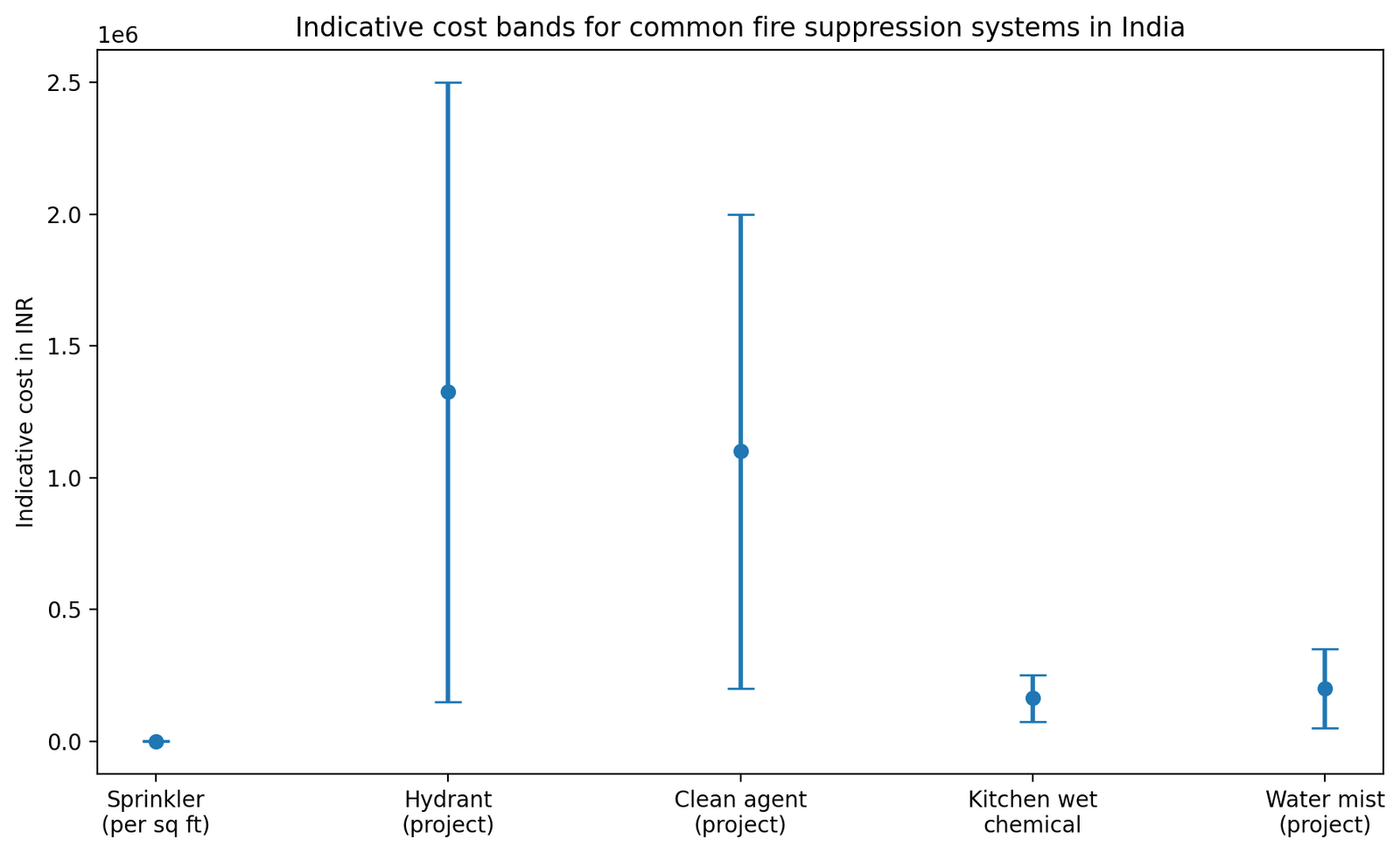
For sprinklers, Indian contractor pages place installed-budget ranges roughly around ₹50–₹150 per sq ft on one side and ₹150–₹300 per sq ft on the higher side, depending on complexity, height, hazard class, and retrofit difficulty. A realistic planning band for many projects is therefore ₹50–₹300 per sq ft, with retrofits and high-rises tending upward.
For hydrant systems, a common indicative range is around ₹1.5 lakh to ₹10 lakh for large-building systems on one contractor page, while another turnkey contractor shows ₹5 lakh to ₹25 lakh+ depending on scale. Large campuses, industrial plants, and multi-block developments can exceed that.
For clean-agent systems, general contractor guidance puts gas suppression at roughly ₹2 lakh to ₹20 lakh for IT/server-room type applications. Marketplace listings show the same spread in smaller slices: pre-engineered electrical-panel or Novec/FK-based packages at about ₹50,000–₹75,000, server-room systems around ₹1.85 lakh, and FM-200 room systems around ₹1.5 lakh to ₹3.25 lakh depending on kit size and scope.
For wet-chemical kitchen systems, visible Indian listings commonly sit around ₹75,000, ₹1 lakh to ₹1.18 lakh, and up to ₹2.5 lakh for larger/commercial packages. Final cost depends on the number of nozzles, appliance line-up, hood length, duct protection, cylinder size, and shutdown interlocks.
For water mist, smaller packaged or listed systems appear from around ₹50,000 up to ₹3.5 lakh, but this number becomes very project-specific once engineering, pumps, nozzles, and enclosure requirements are added.
Those are budgetary bands, not tender prices. In India, your final landed cost is heavily influenced by hazard classification, hydraulic demand, pump room, tank capacity, detector integration, local authority comments, ceiling and service coordination, and whether the project is a new build or retrofit.
How to Choose the Right Fire Suppression System?
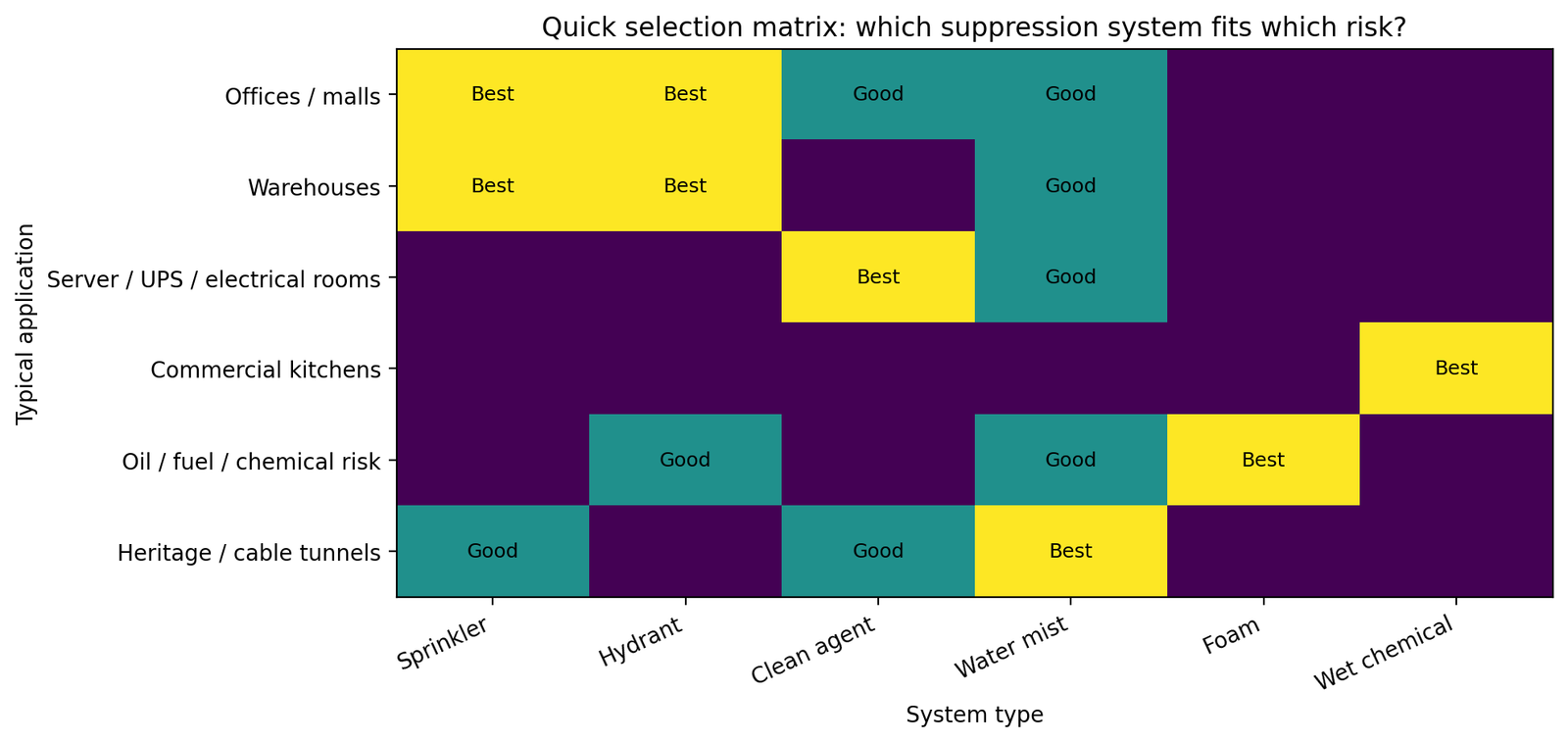
- If the protected asset is the building and its occupants, start with sprinklers and hydrants.
- If the protected asset is electronics or critical infrastructure, look at clean-agent or inert-gas systems.
- If the hazard is fuel or flammable liquid, foam becomes more relevant. If the hazard is commercial cooking oil, wet chemical is the specialist answer.
- If the challenge is reduced water discharge with special-hazard engineering, water mist deserves evaluation.
- The first mistake is choosing by price per square foot without defining the hazard.
- The second is treating fire alarm, suppression, pump room, and authority approvals as separate packages.
- The third is buying a clean-agent system without checking enclosure integrity and long-term agent support.
- The fourth is retrofitting a building after interiors are complete, which raises cost and usually worsens maintainability.
- The fifth is ignoring the kitchen and electrical-room hazards because the main building already has sprinklers.
- For a corporate office, hotel, hospital, or mall, start with sprinklers + hydrants + addressable detection, and add clean-agent protection only where water damage is unacceptable.
- For a warehouse or logistics building, sprinklers are usually the backbone, but storage height, commodity class, and loading risks may push the design into more demanding sprinkler or deluge/water-spray territory.
- For a server room, UPS room, battery room, or control room, use clean-agent or inert-gas suppression with proper detection, release logic, and enclosure controls.
- For a restaurant, hotel kitchen, or food court, do not rely on general building sprinklers alone; install a wet-chemical kitchen suppression system for hoods, ducts, and appliances.
- For fuel, chemical, or transformer risks, evaluate foam, water spray, or other special-hazard solutions rather than standard office-type suppression logic.
- IS and NBC-compliant hydraulic design — Smooth NOC approval, first time
- Free site assessment for every client — Right system recommendation before you spend a rupee
- Clean agent + sprinkler + kitchen system expertise — One partner for your complete fire suppression needs
- State Fire Department NOC documentation support — You focus on your business; we handle the paperwork
- Annual Maintenance Contracts (AMC) — System always inspection-ready and compliant
- 4-hour post-discharge response (service locations) — Fastest possible return to service after activation
- Transparent pricing — no hidden costs — Budget with confidence
In other words, the right question is not “Which system is best?” but “Best for what hazard, in what occupancy, under which approval regime, with what asset sensitivity?” NBC explicitly frames fire safety around occupancy and hazard, which is exactly why copy-paste fire specs often fail in India.
Fire Suppression Systems Installation Guide for Indian Projects
Step 1: Start with occupancy, hazard, and code mapping
Begin with the building’s occupancy, floor area, height, basement conditions, risk processes, storage arrangement, and asset sensitivity. Then map the applicable standards: NBC Part 4 for overall fire/life-safety framework; IS 15105 for sprinklers; IS 2189 for detection/alarm; IS 15301 for pumps; IS 3844 and IS 13039 for hydrants; IS 15493 plus agent-specific standards for gaseous systems; IS 15519 for water mist.
Step 2: Prepare a design basis report
Before drawings, write down the design assumptions: hazard class, required coverage, water source, required pump duty, enclosure integrity for gas systems, release logic, shutdowns, battery backup, false-ceiling risks, and interface with HVAC, BMS, lift recall, smoke control, and emergency power. IS 2189 is especially important here because it explicitly envisions alarm systems triggering extinguishing processes and other ancillary services.
Step 3: Get authority input early
Because fire service is a State subject, approval pathways differ. NBC also notes that for alterations or partitioning above certain thresholds in high-rise buildings, approval of the local fire authority is required. Practically, that means major projects should not wait until installation to discover approval comments. Submit concept drawings, schematic layouts, and calculations early.
Step 4: Use third-party-approved components
NBC says it is desirable to use equipment certified under the BIS certification marks scheme. In practice, reputable projects in India also look for recognized third-party approvals for critical components and agents, especially in clean-agent and special-hazard systems. Cheap non-traceable components may reduce capex on paper and increase failure risk in reality.
Step 5: Install the “system,” not just the hardware
A sprinkler project is not merely heads and pipes. It is tanks, pumps, jockey pumps, valves, test lines, drain arrangements, alarm interfaces, supervision, signage, and access for inspection and maintenance. A clean-agent room is not just cylinders; it needs detection logic, release control, hold/release sequence, alarms, room integrity, and post-discharge procedures. A kitchen system is not complete unless it protects the hood, duct, plenum, appliances, and utility shutdown logic.
Step 6: Commission properly
Commissioning should include pressure tests, hydrotests where applicable, pump performance verification, alarm cause-and-effect checks, detector tests, supervisory signal checks, manual release tests, discharge simulation or approved acceptance protocol, and as-built documentation. If the system is addressable or integrated, test the full sequence from detection to alarm to release to shutdown to annunciation.
Step 7: Train and maintain
IS 2189 and IS 15301 are both maintenance-oriented, and NBC emphasizes operational readiness. The biggest failure point in India is often not design but neglect after handover: locked valve rooms, isolated pumps, bypassed detectors, discharged cylinders not refilled, kitchen nozzles clogged with grease, or false ceilings modified without redesign. A fire system that is not tested and maintained is a false sense of security.
Common Mistakes Indian Building Owners Make when Choosing a Fire Suppression System
A Practical Shortlist by Property Type: Which Fire Suppression System to Choose?
Final word
The best fire suppression systems in India is rarely the cheapest and almost never the most fashionable. It is the one that matches the actual hazard, fits the occupancy, satisfies the applicable Indian standards and local fire authority, and remains testable and maintainable after handover. For most buildings, that means layered protection: detection + sprinklers/hydrants + specialist suppression where the hazard demands it. That is the difference between a system installed for paperwork and a system engineered to save lives, assets, and business continuity.
12. Why Choose APS Fire Protection Solutions
At APS Fire Protection Solutions, we understand that fire safety in India comes with unique challenges: diverse building types, varying state-level regulations, budget pressures, aggressive timelines, and the constant need to balance NBC compliance with practical installation realities.
We have built our reputation on being the company that gives every client the system they actually need — designed correctly, installed properly, and maintained consistently. Our engineers do not push the most expensive solution. They specify the most appropriate one.